Relational data
Linked records for customers, vendors, requests, approvals, files, invoices, projects, and owners.
Airtable Alternative
Airtable is useful when you need a flexible database. Kintable is for teams that need the system around the database too: forms, approvals, automations, portals, dashboards, integrations, permissions, and AI-generated structure from one prompt.
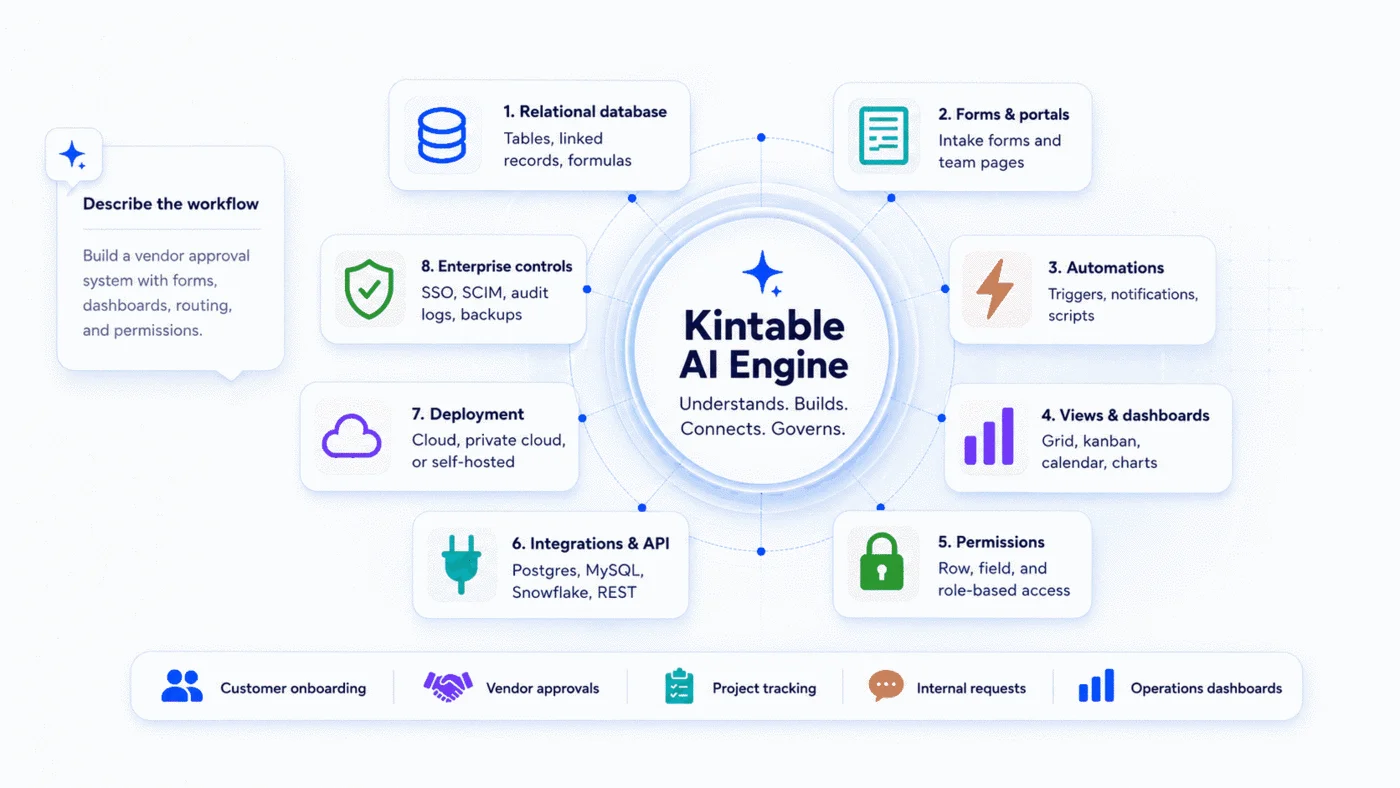
The short answer: Airtable is a flexible no-code database. Kintable is an AI system builder. If your work needs records plus intake, approvals, automations, portals, integrations, permissions, and audit history, Kintable gives the process a home instead of asking your team to assemble one from parts.
This comparison is intentionally practical. Airtable can be a good fit for database-first teams. Kintable is built when the database needs to become a governed workflow system.
| Need | Kintable | Airtable-style database workflow |
|---|---|---|
| Start from plain English | One prompt creates tables, forms, approval routes, views, automations, and portals. | Teams usually design fields, views, forms, and automations manually. |
| Run approvals | Approval stages, routing logic, status, audit history, and notifications live in one system. | Often requires manual setup or external automation glue. |
| Client or vendor portals | External users see only the records and actions they are allowed to see. | Portals may require add-ons, separate tools, or custom setup. |
| Workflow ownership | The trigger, record, permissions, history, and actions stay together. | Workflows can spread across bases, forms, scripts, and external automation tools. |
| Best fit | Business teams that need a governed system around messy work. | Teams that need a flexible database and are comfortable assembling the process. |
Kintable starts where spreadsheet-database tools often stop: the work that happens after the record exists.
Linked records for customers, vendors, requests, approvals, files, invoices, projects, and owners.
Forms that collect the right data and write it directly into the governed system.
Conditional routes for finance, legal, managers, customers, vendors, or internal teams.
Email, Slack, invoice drafts, reminders, status updates, and cross-tool actions connected to the record.
Client or vendor access with only the right data exposed, not the whole internal workspace.
Permissions, SSO, audit logs, and data controls for work that becomes business-critical.
Good prompts describe the work, not the software configuration.
"Create a vendor approval system with supplier intake, NDA upload, spend thresholds, finance routing, legal review, vendor status portal, Slack alerts, and monthly approval reporting."
The honest answer converts better than hype. Use the right tool for the job.
The process needs data, forms, approvals, automations, portals, permissions, audit history, and integrations working together.
You mainly need a flexible database, lightweight collaboration, or a manually assembled workspace your team is comfortable maintaining.
Short answers for buyers comparing database, workflow, and automation tools.
For teams that only need a flexible database, Airtable can be a strong fit. For teams that need the full system behind the work - intake forms, approvals, automations, portals, audit history, integrations, and AI-generated structure - Kintable is designed for that broader job.
Airtable is a flexible database that teams assemble by hand. Kintable starts from a plain-English prompt and generates the connected system: governed records, forms, approval logic, automations, dashboards, portals, and integrations.
For workflows where records, approvals, automations, and audit history need to live together, Kintable can replace a stack assembled from Airtable plus external automation tools. If you only need simple app-to-app notifications, a standalone automation tool may be enough.
Kintable will draft the system around it: data, forms, approvals, automations, portals, and integrations.