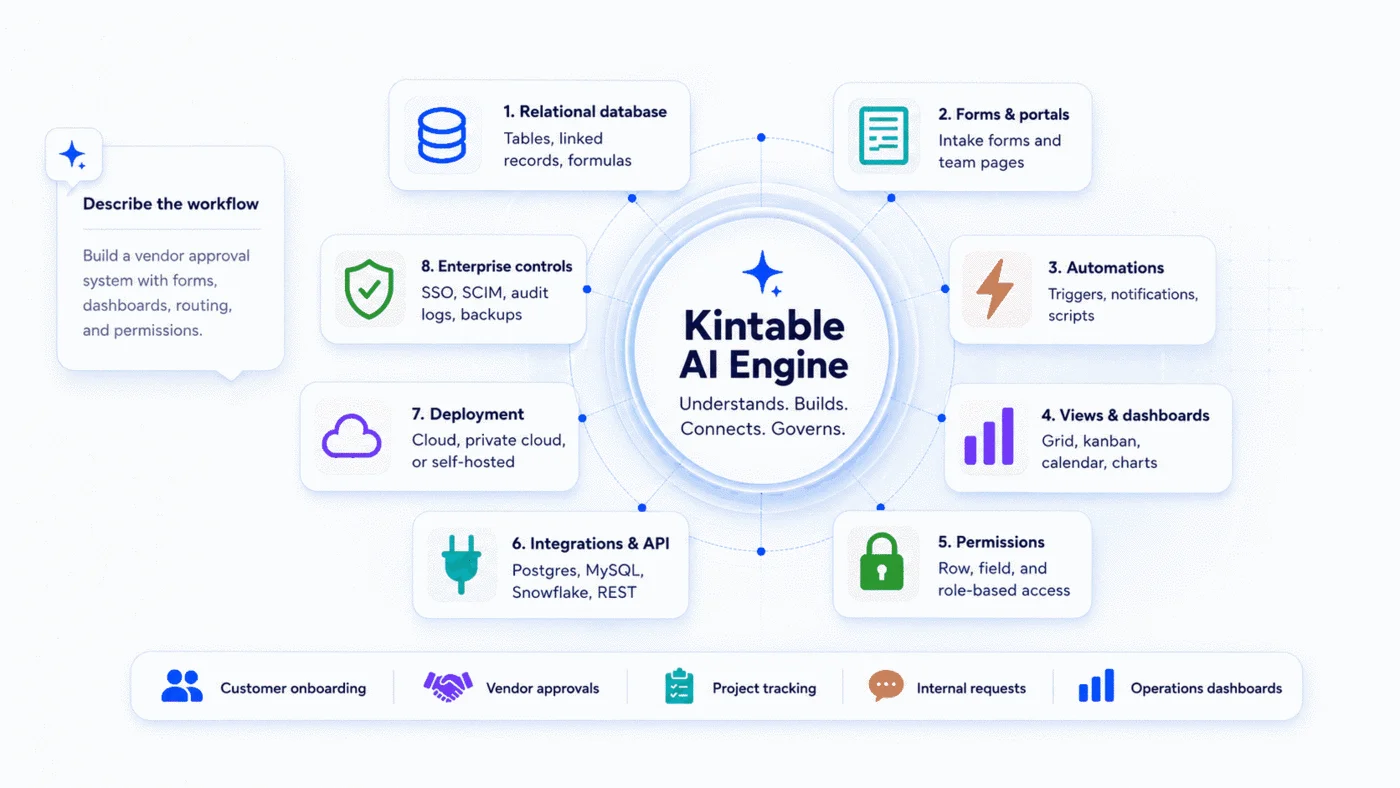
A business process is rarely just a task. It has a request, people, decisions, dates, files, exceptions, customer-facing updates, and data that must stay consistent. That is why teams outgrow single-purpose AI assistants quickly. The real value is not a faster answer. It is a working system.
An AI business system builder starts with the outcome you describe in plain English, then creates the structure needed to run it. In Kintable, that means one prompt can become a governed workspace with records, role-aware views, routing rules, client or vendor access, and the tool connections that keep work moving.
Why a system matters more than a generated screen
A generated screen looks impressive in a demo. A system earns trust in daily use. Can the team tell what is waiting, who owns it, what changed, and what happens next? Can a customer submit something without seeing internal notes? Can finance see approvals without asking operations to export a spreadsheet?
Those are system questions. If the answer depends on five disconnected tools, the process will eventually slow down. If the answer lives in one connected workspace, the team can act with confidence.
What to describe in the prompt
Good prompts describe the work, not the software. Instead of naming tables and automations, write the process as your team would say it: "When a partner submits a new deal, collect the details, route it to the right owner, notify finance if the value is above $25,000, and give the partner a portal to track status."
That kind of prompt gives AI enough context to build the business logic around the work. Kintable can then turn the messy sentence into an organized system your team can inspect, refine, and launch.
When this approach is the right fit
Use an AI business system builder when the process has repeatable steps, multiple people, shared data, or external stakeholders. It is especially useful for client onboarding, vendor approvals, project intake, partner programs, service requests, and internal reviews.
Use a document, chat assistant, or spreadsheet when the work is one-off and does not need status, permissions, reporting, or a record of what happened.
The business case
The immediate benefit is speed. Teams can move from idea to working draft without waiting for engineering. The deeper benefit is consistency. Kintable gives the process a home, so the team stops translating between forms, spreadsheets, emails, and dashboards.
That is the shift: AI does not just help you think about the work. It starts building the system that runs it.