No-code internal tool builder that enterprise IT will actually approve.
The short answer:A no-code internal tool builder lets operations, finance, and HR teams build governed software — approval workflows, client portals, intake forms, vendor trackers — without writing code. Enterprise-grade means SSO, SCIM, role-based permissions enforced at the data layer, and a full audit trail built in from day one.
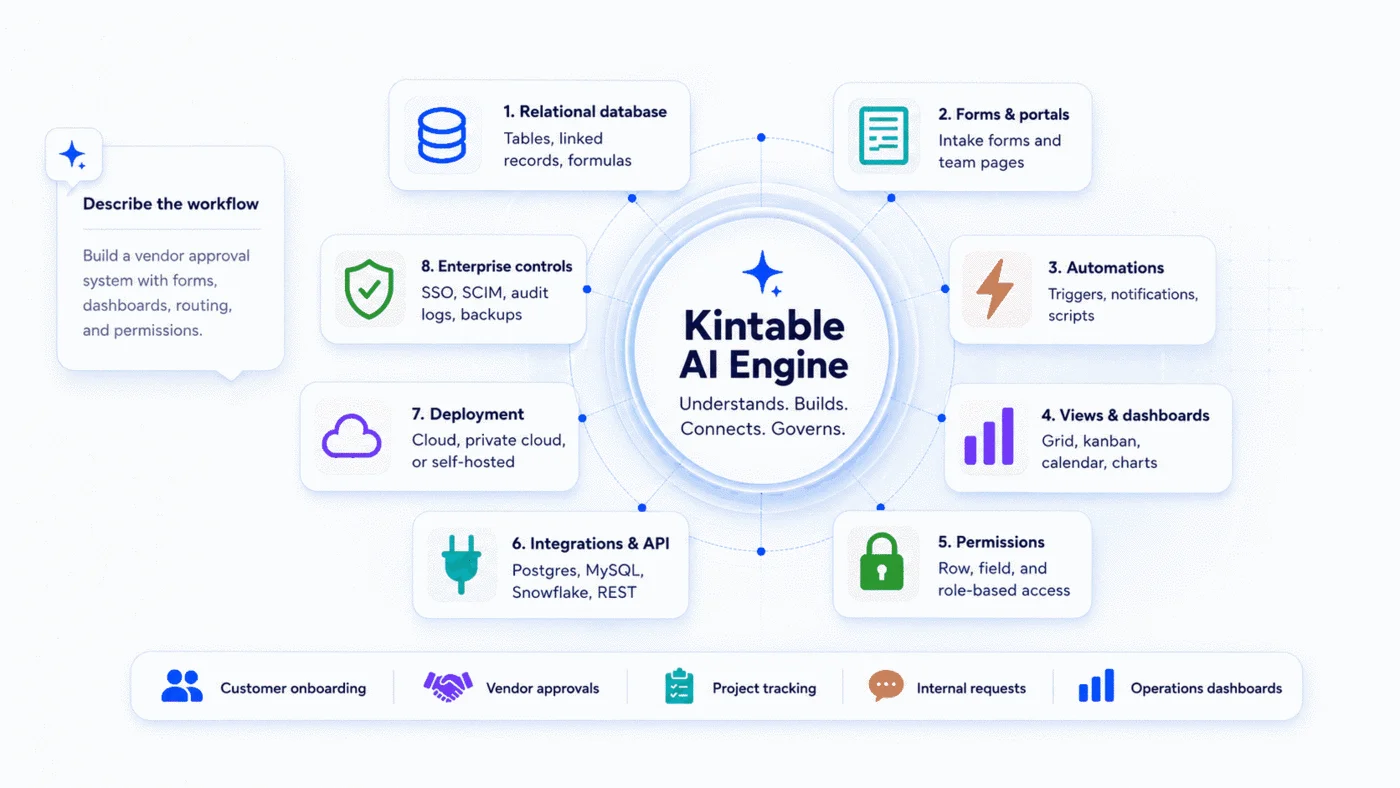
Describe the internal tool your team needs in plain English. Kintable generates the governed system — data model, permissions, workflows, and portal — with SSO, SCIM, audit logs, and role enforcement already built in. No developer sprint. No months-long ERP configuration.
Time to generate and launch a governed internal tool
0
Lines of code needed to build or update the tool
100%
Audit trail — every action logged automatically
SAML 2.0
SSO + SCIM provisioning included
Platform Capabilities
Enterprise-grade internal tools — generated, not coded.
No Retool license for internal dashboards. No Softr subscription for portals. No hand-coded role enforcement that breaks on every update.
auto_awesome
AI-Generated from Plain English
Describe the tool: 'I need a vendor onboarding system where suppliers submit their info, finance reviews it, and legal approves contracts.' Kintable generates the data model, forms, routing, and permissions automatically.
lock
Field & Row Permissions
Control which roles see which fields and records — enforced at the database layer, not just in the UI. Finance sees spend data. Vendors see their own submissions. Admins see everything.
shield_person
SSO & SCIM
SAML 2.0 SSO with Okta, Azure AD, Google Workspace, or any SAML-compatible IdP. SCIM keeps user roles and access in sync with your directory — automatic deprovisioning included.
history
Audit Trail on Every Action
Every record create, update, delete, approval decision, and login is logged with timestamp, actor, and prior state. Export to CSV for compliance review or legal discovery — no engineering request needed.
open_in_new
External-Facing Portals
Give vendors, clients, or applicants a branded portal to interact with your internal tool — submit forms, check status, upload documents — without any access to internal records.
account_tree
Conditional Workflows
Add multi-step approval routing, escalation paths, SLA timers, and status transitions to any internal tool. Logic updates without code changes.
Use Cases by Team
What internal tools do enterprise teams build with no-code builders?
Any process that lives in a spreadsheet, email thread, or undocumented shared drive is a candidate for a governed internal tool.
inventory
Operations
arrow_rightVendor onboarding system with intake forms, document collection, and multi-tier approval
arrow_rightClient onboarding tracker with milestone sign-offs and external portal for status visibility
arrow_rightChange request management with impact assessment and rollback authorization
payments
Finance
arrow_rightPurchase order tool with spend-tier routing and QuickBooks sync
arrow_rightExpense reimbursement with receipt upload, policy check, and manager approval
arrow_rightBudget exception tracker with documentation and finance director sign-off
badge
HR
arrow_rightHeadcount request tool with department, finance, and executive approval chain
arrow_rightEquipment and software provisioning with IT and manager sign-off
arrow_rightOffboarding checklist with access revocation steps and compliance confirmation
gavel
Legal & IT
arrow_rightContract review routing with version history and multi-tier legal sign-off
arrow_rightIT access provisioning with manager, security, and admin approval
arrow_rightCompliance exception tracker with evidence collection and risk documentation
IT & Security Checklist
What IT reviews before a no-code tool goes into production.
Kintable is built to pass the enterprise security review from day one.
verified
Single Sign-On (SSO)
SAML 2.0 SSO with Okta, Azure AD, Google Workspace, and any SAML-compatible IdP. Users authenticate through your existing identity provider — no separate credentials.
verified
SCIM Provisioning
Automatic user provisioning and deprovisioning via SCIM. Employee access is revoked when they leave your IdP — no manual offboarding step that gets missed.
verified
Role-Based Access Control
Field-level and record-level permissions enforced server-side at the database layer — not just hidden in the UI. Each role sees exactly what their permissions allow.
verified
Exportable Audit Logs
Every action — record changes, approvals, logins, file uploads — logged with timestamp and actor. Admins export to CSV for compliance or legal review without an engineering ticket.
verified
Data Encryption
AES-256 encryption at rest, TLS 1.2+ in transit. Region selection available for teams with data residency requirements.
No-code internal tools for enterprise: common questions answered.
For IT, operations, and engineering leads evaluating no-code internal tool builders for enterprise use.
About Kintable: an AI-powered B2B operations platform (kintable.ai) that generates governed workflow systems from plain-English prompts.
What is a no-code internal tool builder?
A no-code internal tool builder lets non-developers — operations managers, finance leads, HR teams — create governed software applications without writing code. Enterprise-grade builders add SSO, SCIM, field-level permissions, and audit trails so the resulting tools pass IT security review, not just satisfy a departmental need.
How is Kintable different from Retool or Softr for internal tools?
Retool is developer-first — you write JavaScript to configure data sources and UI components. Softr is end-user-first but lacks enterprise permission controls. Kintable is AI-first: describe the tool in plain English and the system generates the data model, permissions, and workflow routing automatically — with enterprise controls built in, not configured later. See our Retool alternative page for a detailed comparison.
Can no-code internal tools connect to our existing databases or APIs?
Yes. Kintable connects via REST API, webhooks, and native integrations. Data can sync bidirectionally with your CRM, ERP, HRIS, or accounting tools. The internal tool Kintable generates can read from and write to external systems without custom code.
How do permissions work in a no-code internal tool?
Permissions in Kintable are enforced at the data layer — not just hidden elements in the UI. Field-level permissions control who sees which columns. Record-level permissions control which rows are visible to each role. Permissions are defined in plain English and enforced server-side on every query.
How quickly can we deploy a no-code internal tool in an enterprise environment?
Most teams are live in under an hour. Describe the tool in plain English, review the generated data model and routing rules, configure SSO through your existing IdP, set role permissions, and invite users. IT-required controls are on by default — SSO, audit logging, field permissions — not added as an afterthought.
Describe the internal tool your operations team is managing in a spreadsheet.
Kintable generates the governed enterprise application — data model, forms, routing, permissions, and audit trail — ready for IT review in hours.