Structured records
Linked tables for requests, customers, vendors, owners, approvals, files, tasks, invoices, and outcomes.
Spreadsheet Replacement
Spreadsheets are great for analysis. They break when they become the place your team tracks owners, statuses, approvals, customers, vendors, reminders, files, and weekly follow-ups. Kintable turns that work into a governed system from one prompt.
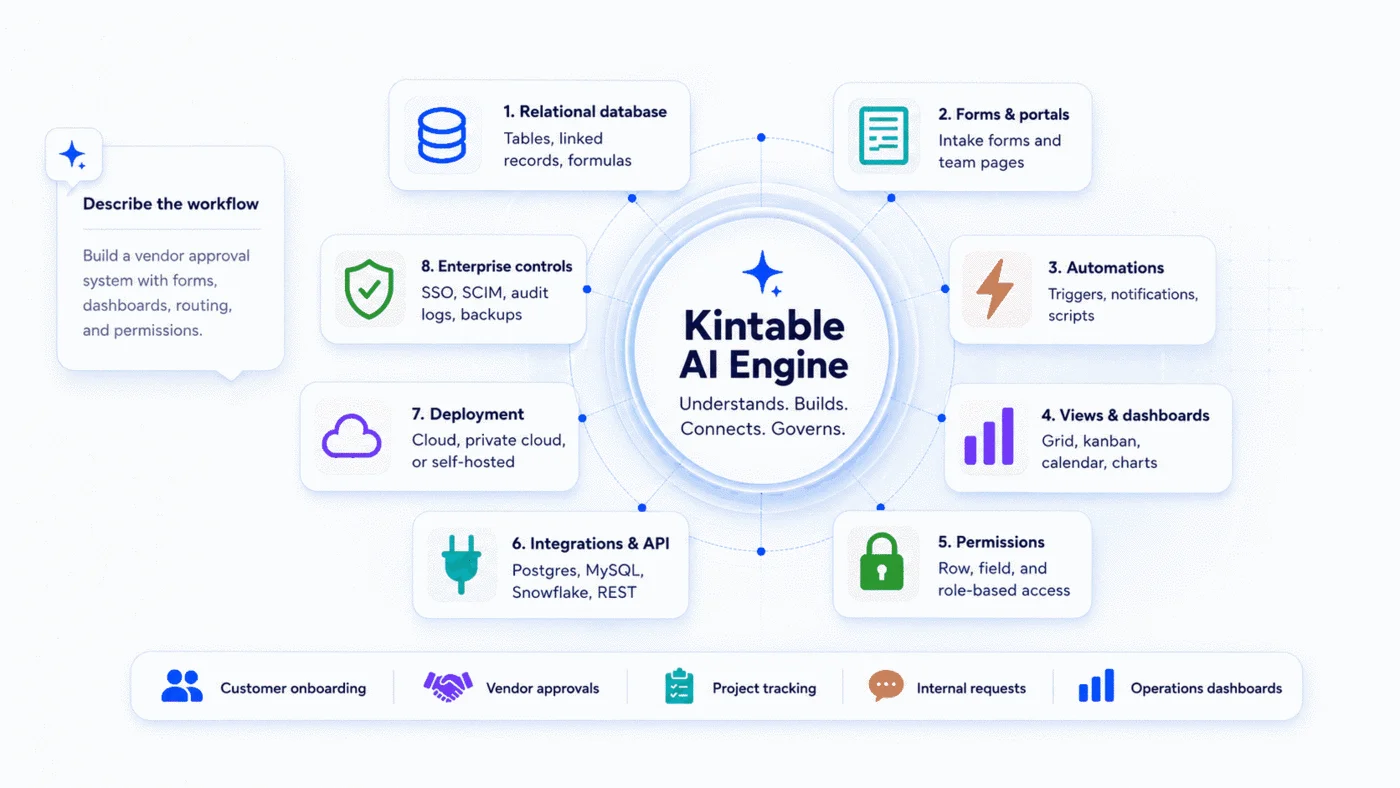
The short answer: Kintable is not trying to replace every spreadsheet. Keep spreadsheets for calculations and ad hoc analysis. Use Kintable when the spreadsheet has become a business workflow that needs intake, owners, approvals, permissions, dashboards, portals, automations, integrations, and a record of what happened.
The real problem is rarely the sheet itself. It is the business process hiding inside it: status changes, handoffs, approvals, exceptions, reminders, external updates, and reports.
| Need | Kintable | Spreadsheet workflow |
|---|---|---|
| Collect requests | Smart intake forms write clean data into the system. | People email rows, edit shared sheets, or duplicate tabs. |
| Track ownership | Every record has owner, status, history, and next action. | Ownership is often a column, a color, or tribal memory. |
| Run approvals | Conditional approval routes, notifications, and audit history stay with the record. | Approvals happen in email, comments, chat, or separate tools. |
| Share with customers or vendors | Portals show only the right records and actions. | Teams share filtered sheets, screenshots, or manual status updates. |
| Connect tools | Gmail, Slack, Stripe, QuickBooks, Shopify, HubSpot, databases, APIs, and more connect to the workflow. | Automations are usually bolted on after the sheet becomes painful. |
| Best fit | Repeatable workflows with people, approvals, permissions, reporting, and external participation. | Analysis, formulas, small lists, and one-person tracking. |
Describe the process in plain English. Kintable creates the system structure around it so the work can move without manual babysitting.
Linked tables for requests, customers, vendors, owners, approvals, files, tasks, invoices, and outcomes.
Forms collect exactly what the process needs and route each record into the right queue.
Spend thresholds, manager routing, legal review, finance checks, customer signoff, and exception paths.
Team queues, kanban boards, calendars, dashboards, and reports over one governed source of truth.
Customers, vendors, partners, or applicants can see only the work they are allowed to touch.
Notifications, reminders, invoice drafts, email updates, Slack alerts, and tool actions stay tied to the record.
The best prompt describes the work your sheet is carrying today.
"Turn our vendor approval spreadsheet into a system with supplier intake, owner assignment, spend threshold approvals, document upload, finance review, vendor status portal, Slack reminders, and monthly approval reporting."
The conversion line is simple: analysis can stay in a sheet. Operations should move into a system.
The sheet has multiple owners, recurring requests, approvals, reminders, external users, audit needs, handoffs, or integrations.
You need calculations, financial modeling, ad hoc analysis, tiny lists, or one-person work that does not require routing or governance.
Spreadsheet replacement is one entry point into the larger AI system builder category.
See how Kintable turns one prompt into governed data, intake, approvals, portals, automations, and integrations.
Compare Kintable with flexible database tools when your spreadsheet has already become a base.
Read the deeper guide on when to move a spreadsheet process into an AI-generated system.
Short answers for teams deciding whether the sheet should become a system.
Spreadsheet replacement means moving a process that has outgrown a sheet into a system with structured records, owners, permissions, intake, routing, dashboards, audit history, and automations.
Kintable is not an Excel clone or spreadsheet editor. It is an AI system builder for teams whose spreadsheet has become a business workflow with approvals, status, handoffs, external users, reporting, or audit needs.
Keep spreadsheets for ad hoc analysis, formulas, lightweight lists, and one-person work. Move to Kintable when the sheet runs a repeatable process across people, customers, vendors, approvals, reminders, or integrations.
Yes. Start by describing the columns, statuses, owners, approvals, and tools in your current spreadsheet process. Kintable can create the system structure and help teams move off spreadsheet-based workflows.
Describe the process in one prompt. Kintable creates the system draft, then you refine it with AI.