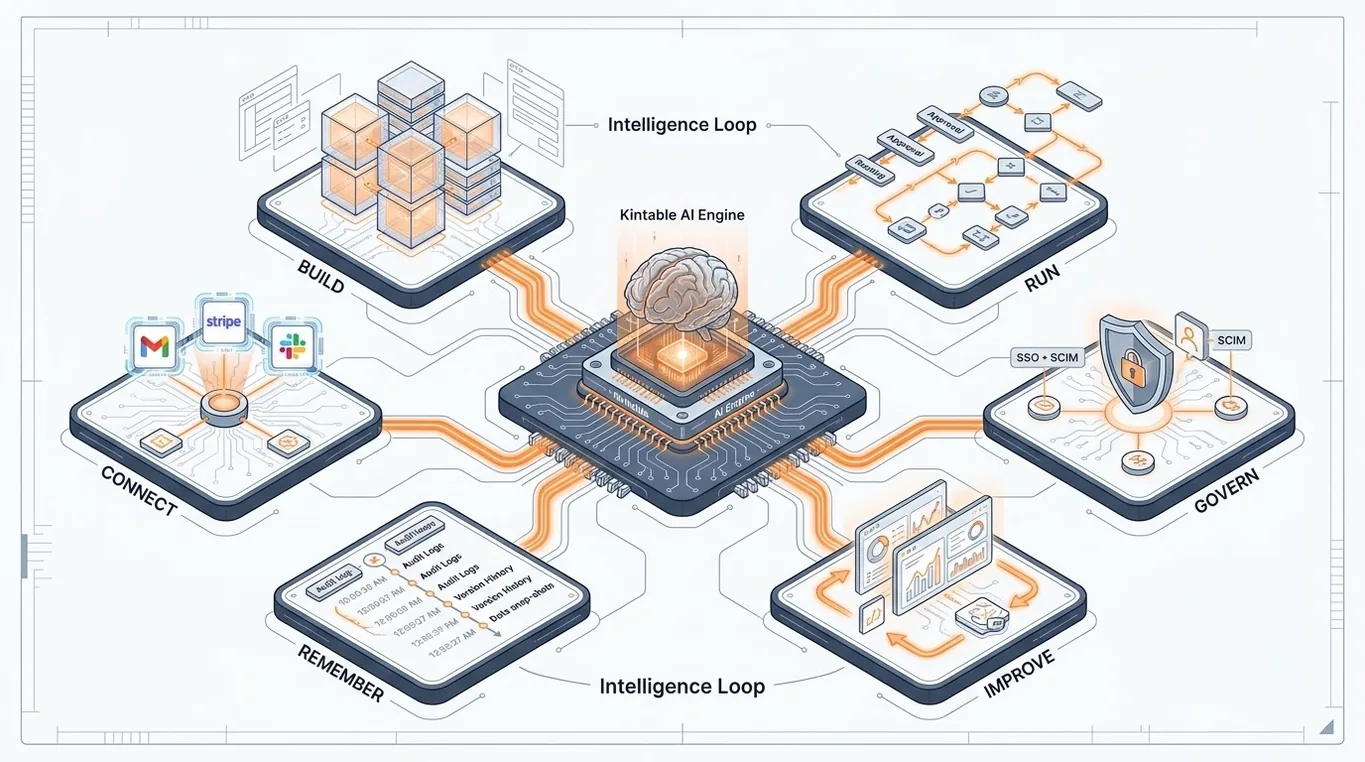
The core idea
The autonomous enterprise is not a chatbot attached to every tool. It is a governed operating loop: goals define what matters, context explains what is happening, actions move work forward, decisions create memory, and feedback improves the next loop. Kintable exists to make that loop practical for real teams.
For the last few years, every company has tried to become AI-first. That usually meant adding copilots, chat interfaces, meeting summaries, and AI-assisted search to the tools teams already use.
That is useful, but it is not the finish line. The next stage is the autonomous enterprise: an organization where AI does not merely answer questions, but helps work move through a governed loop of goals, context, action, decisions, and feedback.
The hard part is not the model. The hard part is the plumbing: connecting AI safely into the tools where work happens, extracting business judgment from people and processes, codifying SOPs, enforcing permissions, documenting actions, and monitoring the system with humans and AI.
The flywheel behind autonomous operations
A self-learning organization needs a loop. Each cycle should make the next cycle smarter, faster, and safer. In practical terms, the autonomous enterprise flywheel has five parts.
What matters, who owns it, what good looks like, and what tradeoffs are acceptable.
History, current status, customer data, budget, resources, approvals, and constraints.
Where work happens across forms, approvals, Gmail, Calendar, Salesforce, Slack, finance tools, and databases.
What was done, why it was done, who approved it, and what the system learned.
The memory layer that improves the next recommendation, route, automation, or escalation.
This is why the autonomous enterprise cannot be built with disconnected prompts alone. A prompt can draft an answer. A governed system can remember the goal, read the context, execute the action, record the decision, and feed the result back into the next loop.
Why AI chat is not enough
AI chat is excellent for analysis, drafting, and exploration. But operational work needs more than answers. It needs ownership, permissions, status, routing, escalation, audit history, and integration with the tools people already use.
Ask a chatbot, "What should we do about this delayed vendor approval?" and it can suggest a next step. But the autonomous enterprise needs a system that can identify the stuck request, check the spend threshold, read the vendor history, draft the message, route it to the right approver, log the decision, update the dashboard, and learn from the cycle.
That is the difference between AI as an assistant and AI as an operating layer.
Business tools
- Gmail, Outlook, Slack
- Calendar, tasks, meetings
- Stripe, QuickBooks, finance
- Salesforce, HubSpot, databases
Kintable system layer
- Relational records and workflow memory
- Routing, approvals, escalations
- Permissions, SSO, audit history
- Dashboards, exceptions, feedback
Closed loop
- AI recommends the next action
- Humans approve sensitive changes
- Decisions become reusable context
- Every loop improves the system
Kintable as the system layer for the flywheel
Kintable is built around the belief that business teams need AI systems, not just AI answers. A team describes the workflow in plain English, and Kintable creates the system behind the work: relational records, intake forms, approval routing, dashboards, portals, automations, integrations, permissions, and audit history.
That makes Kintable a practical AI system builder for autonomous operations. It gives each part of the flywheel a home:
| Flywheel part | What it needs | How Kintable supports it |
|---|---|---|
| Goals | Clear owners, success criteria, SLA rules, approval thresholds, and operational priorities. | Workflow templates, generated fields, role assignments, dashboards, and approval logic tied to business outcomes. |
| Context | Historical records, files, customer data, budget, current state, and system events. | Relational databases, record history, file collection, connected tools, and structured views over live work. |
| Action | Safe execution across tools, notifications, approvals, forms, portals, and integrations. | Automations, webhooks, connected SaaS tools, approval routing, client portals, and managed integrations. |
| Decisions | A record of who decided, why, when, and what changed. | Audit logs, approval history, field history, status updates, and permission-aware records. |
| Feedback | Lessons from each loop that improve the next recommendation or process. | Dashboards, exception tracking, cycle-time visibility, AI guidance, and closed-loop workflow memory. |
The real blocker is plumbing, not intelligence
Most companies already have enough intelligence inside the business. The judgment lives in SOPs, spreadsheets, Slack threads, onboarding docs, approval habits, exception handling, customer history, and the heads of experienced operators.
The problem is that judgment is not encoded into a system AI can safely use. It is scattered across tools. It is undocumented. It changes by team. It depends on the person who happens to be online.
Kintable helps convert that operational judgment into a working system. The prompt becomes the starting point, but the output is not just text. The output is a governed workflow with data, actions, permissions, and feedback built in.
Autonomous does not mean unsupervised
The best autonomous enterprises will not remove humans from important decisions. They will remove the manual searching, copying, chasing, checking, and status updating that prevents humans from making better decisions.
In Kintable, a workflow can still require human approval for high-risk actions, finance exceptions, legal reviews, or customer-impacting changes. The difference is that AI can prepare the context, recommend the next step, draft the action, and record what happened. Humans stay in the loop where judgment matters.
That is especially important for enterprise teams. Autonomous operations need security controls, SSO, SCIM, row-level access, field permissions, audit logs, and clear ownership. Without governance, autonomy becomes risk. With governance, autonomy becomes leverage.
Human judgment, AI momentum
The highest-value pattern is not fully automatic everything. It is AI preparing the work, the system enforcing the rules, and humans approving the moments that need judgment.
Where to start
The right starting point is not a company-wide AI transformation deck. It is one repeatable workflow with clear value and enough complexity to benefit from a system: vendor onboarding, purchase approvals, client onboarding, HR requests, finance exceptions, support escalations, or procurement intake.
Describe the workflow: the goal, the context, the actions, the decisions, and the feedback you want to capture. Kintable can turn that description into an operational system your team can actually run. From there, every loop teaches you what to improve next.
That is how the autonomous enterprise becomes real: not as a slogan, but as a set of governed loops that compound.
Key takeaways
- The autonomous enterprise is a closed loop of goals, context, action, decisions, and feedback.
- AI chat can answer questions, but autonomous operations need governed systems that can act and remember.
- The hardest work is plumbing: connecting tools, codifying judgment, enforcing governance, and monitoring outcomes.
- Kintable turns plain-English workflows into the system layer needed for closed-loop business operations.
Build your first autonomous workflow loop
Describe a repeatable business process. Kintable creates the records, forms, approvals, dashboards, portals, integrations, permissions, and feedback layer around it.