If you're reading this, you probably run an operations team. And if you run an operations team, your "tech stack" for managing a workflow like vendor approvals or client onboarding probably looks something like this:
- Airtable (to hold the data)
- Typeform (to collect the intake)
- Zapier (to route notifications to Slack and email)
- Retool (because someone finally realized Airtable interfaces weren't enough for the external clients)
This is the standard 2026 "no-code operations stack." And it is broken.
It's not broken because the individual tools are bad. Airtable is a fantastic spreadsheet-database hybrid. Zapier connects everything. Retool is great for engineers building internal tools.
It is broken because assembling a system from parts is fundamentally more expensive, more fragile, and less secure than generating a unified system. Here is a breakdown of why operations teams are looking for an Airtable alternative, and why Kintable was built to replace the entire assembled stack.
The Hidden Costs of the Assembled Stack
When comparing tools, teams usually look at the sticker price: $24/user/month for Airtable, $29/month for Zapier, etc. But the license fee is the smallest part of the total cost of ownership (TCO).
1. The "Integration Tax"
If you have an Airtable base connected to a Zapier automation that feeds a Retool dashboard, what happens when you need to change a column name?
You have to change it in Airtable. Then you have to log into Zapier, re-map the field in three different Zaps, and test it. Then you have to log into Retool, update the SQL or API query, and push to production. What should have taken 30 seconds takes two hours and creates three points of failure. We call this the Integration Tax, and you pay it every time your business process changes.
2. The Engineering Bottleneck
Tools like Retool are marketed to "builders," but the reality is they require developers. They use SQL, JavaScript, and API connections. If an operations manager wants to change how a client portal looks in Retool, they have to submit an IT ticket.
3. The Security and Audit Gap
Compliance teams (SOC2, HIPAA) hate the assembled stack. Why? Because the audit trail is fractured. If a vendor is approved, Airtable shows the record changed. Zapier shows an automation ran. But who actually clicked "Approve"? In a multi-tool setup, proving a secure chain of custody is nearly impossible without expensive enterprise logs across three different vendors.
Kintable: The Generated System Alternative
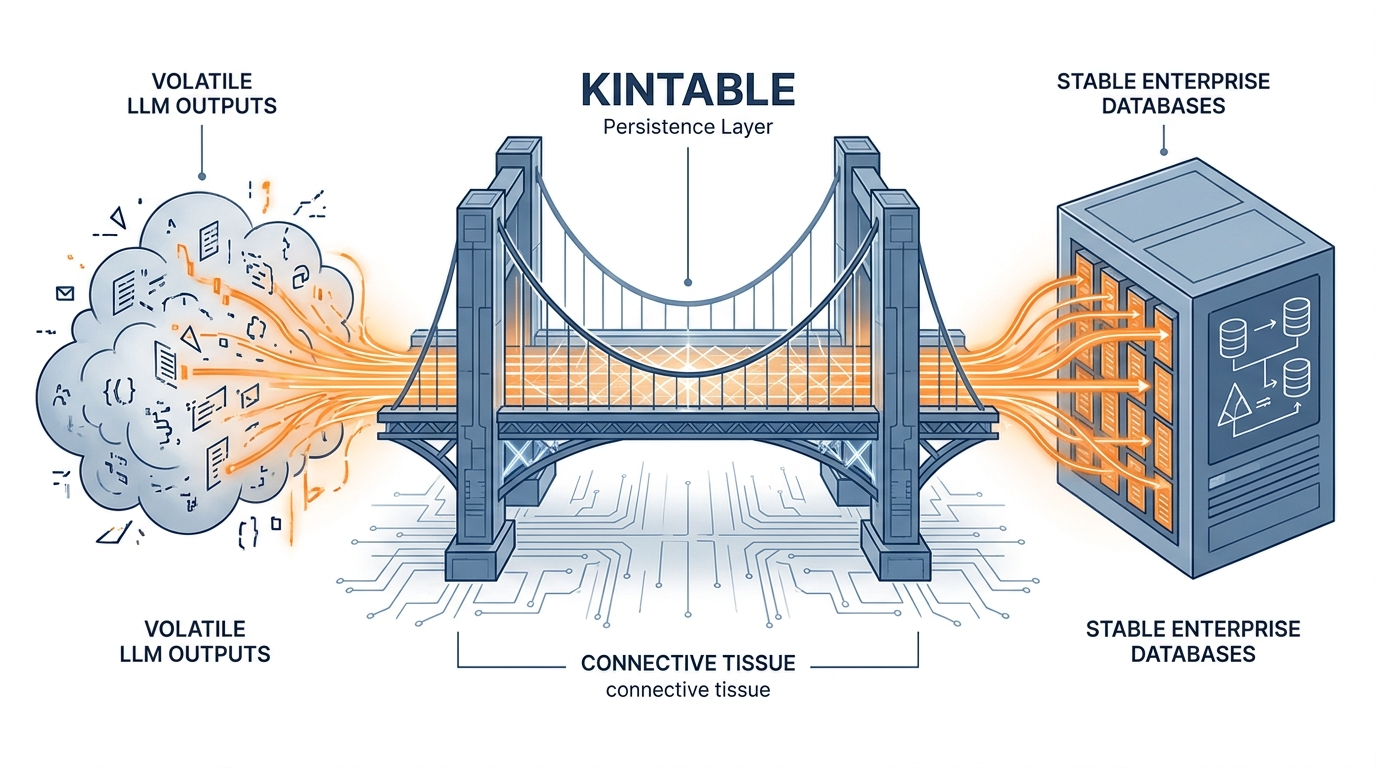
Kintable is an AI-native no-code platform that generates complete operational systems from one prompt. It is a direct alternative to the Airtable + Zapier + Retool stack because it provides the database, the automations, and the application interfaces in one unified environment.
Here is how Kintable compares directly to the assembled stack:
| Feature | Airtable + Zapier + Retool | Kintable |
|---|---|---|
| Architecture | Assembled via APIs and webhooks | Unified (Database + Apps + Logic) |
| Creation Method | Manual drag-and-drop & coding | Generated from a plain-English prompt |
| Time to Launch | 3–6 weeks | Under 1 hour |
| Engineering Needed? | Yes (for Zaps and Retool APIs) | No. 100% no-code operations platform. |
| Audit Trail | Fractured across 3 platforms | Unified, immutable log of every action |
| Security (SSO, SCIM) | Requires 3 separate Enterprise contracts | Standard on all team plans |
| Client Portals | Requires expensive external sync tools | Generated natively, distinct from internal views |
Airtable Alternative: The Database vs. The App
Airtable revolutionized how teams manage data by making databases look like spreadsheets. But operations teams don't just manage data; they manage workflows. They need forms, multi-step approvals, guarded actions, and portals.
Kintable replaces Airtable by providing a robust, relational database backend (built on PostgreSQL architecture), but instead of forcing you to work in a grid, Kintable generates actual applications on top of that data. If you need a vendor approval portal, Kintable generates a portal interface, not just a filtered spreadsheet view.
Zapier Alternative: Native Logic vs. Duct Tape
Zapier is incredible for pushing data from Tool A to Tool B. But using Zapier to run your core business logic (e.g., "If amount > $10k, route to VP, wait for approval, then notify finance") results in incredibly fragile, branching "Zaps" that break silently when data types change.
Kintable replaces Zapier for internal workflows because the logic engine is native to the database. You define the workflow rules in Kintable, and they execute with 100% reliability because there are no API rate limits or webhook delays between the data and the action. (For connecting to external tools, Kintable has 116+ native integrations, including Gmail, Slack, and Stripe, built right in).
Retool Alternative: Prompt vs. Code
Retool is for engineers. Kintable is for operations teams.
If you want to write SQL queries and JavaScript transformers to build a custom internal dashboard, Retool is excellent. But if you are an Operations Manager who just needs a working dashboard and client portal to track onboarding, Kintable will generate it for you in seconds based on your prompt.
The Bottom Line on TCO
When you calculate the true cost of the assembled stack in 2026, it looks like this:
- Airtable Enterprise: ~$45/user/mo
- Zapier Company: ~$100+/mo (usage based)
- Retool: ~$50/user/mo
- Plus: 20 hours a month of an engineer or "ops wizard" fixing Zaps and updating APIs.
Kintable provides the unified system—database, automations, apps, and portals—starting at a fraction of the cost, with zero engineering time required. See our pricing page for details.
Stop assembling. Start generating.
Describe the system you've been trying to build across three different tools. Watch Kintable generate it in seconds.
Try the prompt builder