Structured records
Linked data for requests, customers, vendors, approvals, tasks, files, invoices, owners, and outcomes.
Retool Alternative
Retool is useful when technical teams want to build internal software. Kintable is for business teams that need the complete system behind the work generated from a prompt: data, intake, approvals, portals, dashboards, automations, integrations, permissions, and audit history.
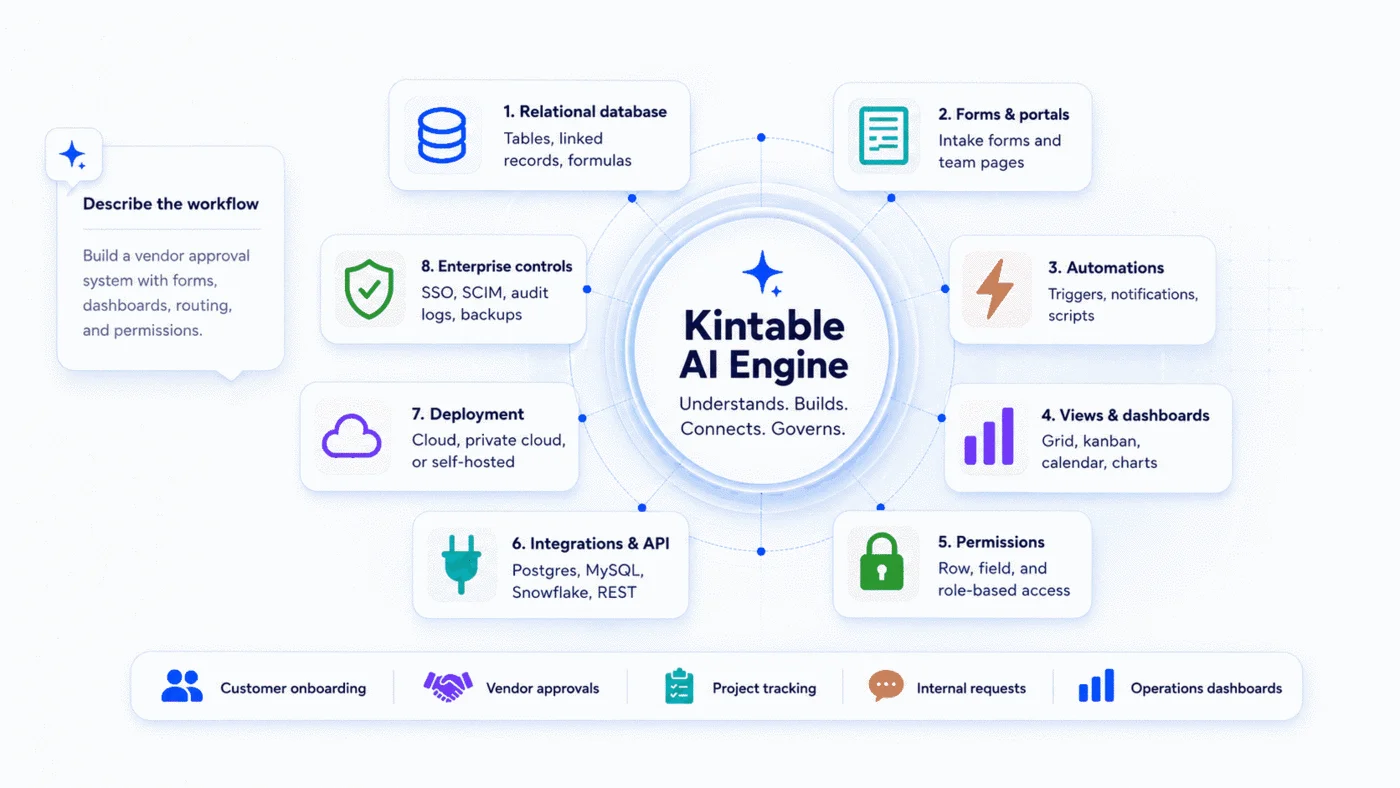
The short answer: Retool is strong for technical teams building custom internal software. Kintable is stronger when the work is a business process that needs to move now: intake, records, approvals, portals, dashboards, automations, integrations, and governance generated together from plain English.
If engineering wants a configurable internal tool platform, Retool may be right. If operations, finance, HR, customer success, or procurement needs a governed workflow system without waiting in the backlog, Kintable is built for that job.
| Need | Kintable | Retool-style internal tool platform |
|---|---|---|
| Start from plain English | One prompt creates the workflow system: records, intake, routing, views, automations, and portals. | Technical teams typically assemble the app, data queries, UI, and logic. |
| Business-team ownership | Teams refine workflows by describing changes in plain English. | Changes often depend on technical builders or internal tool owners. |
| Approvals and audit history | Approval routes, permissions, status, and history stay with the record. | May require custom implementation choices and governance setup. |
| External portals | Client, vendor, partner, or applicant portals are generated with the internal workflow. | External access usually needs careful custom design and permission modeling. |
| Best fit | Operational workflows that need to launch quickly with governance included. | Technical teams building custom internal software with deeper implementation control. |
Kintable is useful when the request is not just "build a screen," but "make this business process work end to end."
Linked data for requests, customers, vendors, approvals, tasks, files, invoices, owners, and outcomes.
Forms and portals collect clean data and create workflow records without manual triage.
Conditional review paths for managers, finance, legal, customers, vendors, or internal teams.
Queues, SLA risk, overdue records, blocked work, workload, approvals, and reporting views.
Email, Slack, invoices, CRM updates, reminders, status changes, and cross-tool actions tied to each record.
Permissions, audit history, SSO-ready controls, and external access boundaries for business-critical work.
The strongest prompt explains the process, the roles, the rules, and the systems that need to stay connected.
"Create a purchase request system for department leads. Employees submit requests with vendor, budget, and documents. Route under $2,500 to managers, over $2,500 to finance, show requesters status in a portal, notify Slack when approvals are stuck, and give finance a dashboard of pending spend."
The more the work depends on process ownership, approvals, external participants, and operational reporting, the more Kintable fits.
Operations, finance, HR, customer success, procurement, or service teams need intake, approvals, portals, dashboards, automations, and audit history without waiting on engineering.
Your technical team wants deep implementation control over custom internal apps, interfaces, queries, scripts, and developer-owned tooling.
Most teams looking for a Retool alternative are also weighing workflow builders, internal tool backlogs, and assembled no-code stacks.
See how one prompt creates intake, records, routing, approvals, automations, dashboards, and audit history.
Learn how AI-generated systems reduce the queue of business tools waiting on engineering.
Compare Kintable with Airtable, Zapier, Make, Retool, Bubble, Softr, Glide, and more by use case.
Short answers for teams deciding whether they need an internal tool platform or a generated workflow system.
Retool can be a strong fit for technical teams building custom internal tools. Kintable is a better fit when business teams need the workflow system itself generated from a prompt: data, intake, approvals, portals, automations, integrations, permissions, and audit history.
Retool focuses on building internal software and automations. Kintable focuses on generating governed business workflow systems from plain English, including the records, forms, approval logic, external portals, dashboards, and connected actions behind the work.
Choose Retool when your engineering or technical operations team wants deep control over custom internal apps, queries, and interfaces. Choose Kintable when the business team wants to describe the process and get the workflow system generated quickly.
Yes. Kintable is designed for teams that need vendor approvals, onboarding trackers, client portals, intake workflows, finance reviews, and similar business systems without turning every request into an engineering project.
Kintable creates the system draft, then you refine it with AI.