Vendor database
Vendor records linked to contracts, purchase requests, approval history, spend limits, contacts, documents, and compliance status.
AI Database Builder
Kintable turns a plain-English description of your process into a relational database: tables, fields, relationships, forms, views, permissions, automations, and audit history — ready to run, not just ready to fill in.
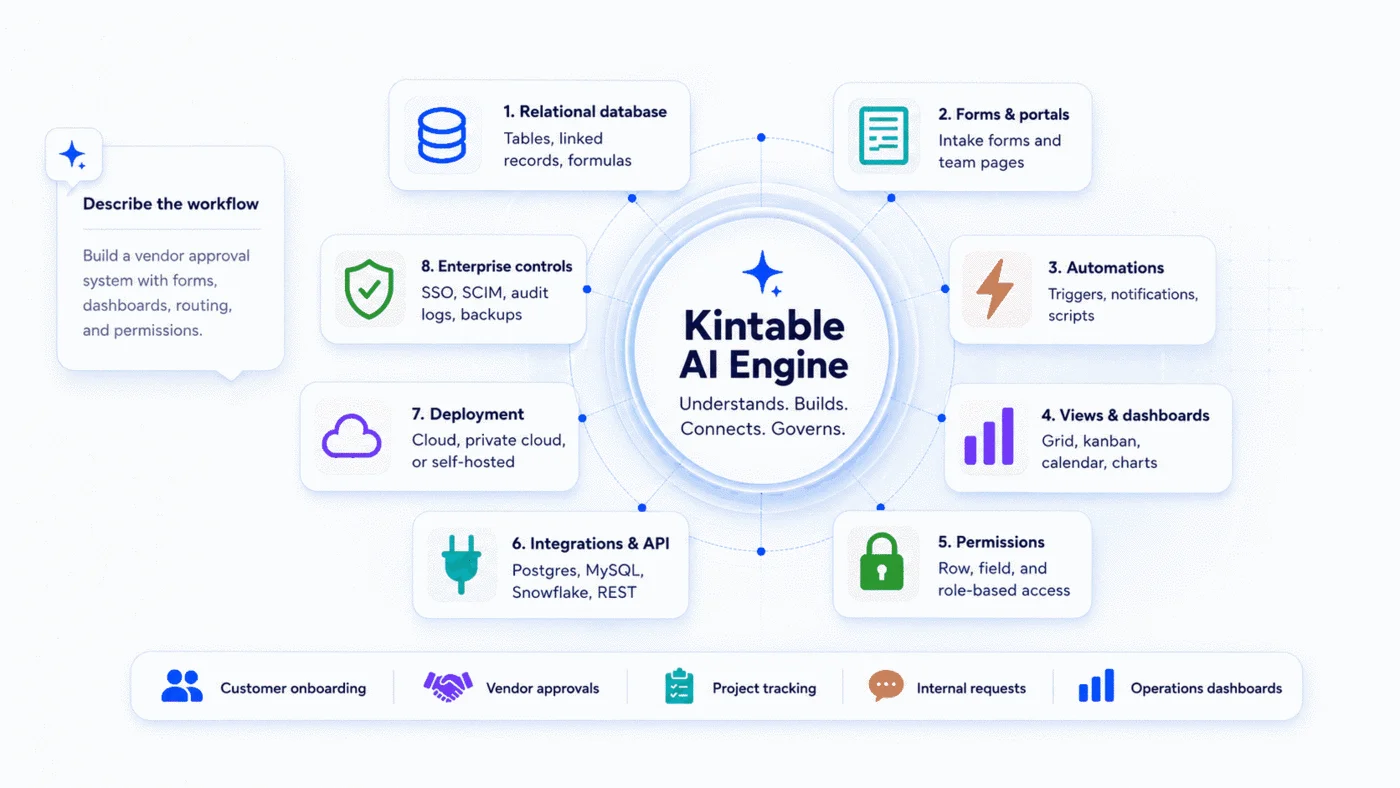
The short answer: Kintable is an AI database builder for business operations — not just data storage. If the database needs intake forms, ownership, approval routing, automations, portals, shared access, reporting, or audit history, Kintable generates the whole system, not just the tables.
These examples show operational databases — linked records, intake, approval routing, and connected tools all generated from one prompt.
Vendor records linked to contracts, purchase requests, approval history, spend limits, contacts, documents, and compliance status.
Clients linked to projects, milestones, tasks, team members, files, portal access, and kickoff checklists — with status dashboards.
Candidates linked to roles, stages, interviewers, scorecards, offer records, and decision audit trail across the hiring team.
Requests linked to requestors, budget categories, approvers, vendors, PO drafts, and payment records with department reporting.
Properties linked to units, tenants, maintenance requests, contractors, work orders, invoices, and resolution history.
Applications linked to applicants, reviewers, scores, committee decisions, award amounts, reporting milestones, and audit history.
Building a database manually is one part of the job. Adding intake, routing, automations, permissions, and portals around it is the rest — Kintable generates all of it together.
| Need | Kintable | Typical database tool |
|---|---|---|
| Start from plain English | One prompt generates tables, relationships, forms, views, permissions, automations, and portals. | You usually define schema manually: tables, field types, relationships, and views one by one. |
| Intake data | AI-generated forms and portal pages write directly to the database with validation and routing. | Forms often require a separate tool or manual connection to the database. |
| Run approvals | Approval stages, reviewers, conditional routing, and audit history live inside the database record. | Approvals typically require a separate workflow tool wired to the database. |
| Share externally | Client and vendor portals with row-level permissions are generated alongside the internal database. | External sharing usually requires a separate portal or custom app layer. |
| Connect tools | Gmail, Slack, QuickBooks, HubSpot, Stripe, Shopify, and APIs connect to records automatically. | Integrations often require a separate automation layer like Zapier. |
| Best fit | Operational business databases with intake, owners, approvals, portals, reporting, and governance. | Pure data storage, analytics, or simple personal/team databases without workflow needs. |
Kintable generates the full operational layer — not just the schema — so teams can use the database without waiting on developers to build the interface, automations, and portals.
Linked tables with correct field types, relationships, and views generated from your process description — no schema design required.
Forms and intake flows that write to the database with validation, conditional fields, and automatic record creation.
Row-level security, role-based access, and external sharing boundaries generated with the database so access is right from day one.
Email, Slack, reminders, CRM updates, and cross-tool triggers tied to record status changes — no separate automation tool required.
Grid, kanban, calendar, gallery, and reporting views generated for each table so teams can see the data the way they need to act on it.
Every record change, approval decision, and automation action is logged so the business can review, report, and stay compliant.
Kintable figures out the tables, relationships, and fields. You describe what the business needs to track and how the process works.
"Build a vendor management database. Track vendors, their contacts, contracts, and compliance documents. Link each vendor to purchase requests. Route requests under $5,000 to the manager and over $5,000 to finance and legal. Notify the vendor by email when approved and show finance a dashboard of open requests by department."
If the data needs owners, intake, approvals, shared access, automations, reporting, or audit history — it is a business process, not just a data store.
The database tracks work with owners, statuses, approval stages, external access, automations, integrations, reporting, permissions, or audit requirements.
You need personal data storage, financial analysis, formula-heavy models, or a simple shared spreadsheet without workflow or governance requirements.
These pages help buyers understand how the database fits into the workflow, portal, and automation layers Kintable builds together.
Understand how Kintable builds the full system: database, forms, approvals, portals, automations, and integrations from one prompt.
See how Kintable turns a workflow description into intake, routing, approvals, automations, dashboards, and audit history.
Compare Kintable and Airtable on AI generation, approval routing, portals, governance, and workflow management.
When to move a spreadsheet to a governed database with intake, owners, approvals, automations, and reporting.
Tactical guide for operations teams moving from spreadsheets to governed AI-generated database systems.
Browse database and workflow systems Kintable can generate across vendor management, onboarding, recruiting, finance, and more.
Short answers for teams deciding whether their data belongs in a spreadsheet, a database tool, or a governed business system.
An AI database builder generates a relational database structure from a plain-English description of your business process — including tables, fields, relationships, forms, views, permissions, and automations — without requiring SQL or developer knowledge.
Airtable and Notion let you build databases manually. Kintable generates the full database structure from a prompt, then adds the workflow layer on top: intake forms, approval routing, automations, portals, permissions, and audit history.
Yes. Kintable generates linked relational tables — for example, vendors linked to purchase requests, linked to approval records — from a plain-English description. No SQL, no schema design required.
Use a spreadsheet when you need analysis, formulas, or personal tracking. Use Kintable when the spreadsheet has become a business process with owners, intake, approvals, shared access, automations, portals, reporting, or audit history.
Kintable can generate databases for vendor management, client onboarding, project tracking, recruiting pipelines, grant applications, purchase requests, inventory, incident tracking, property management, and most other operational business processes.
Kintable generates the relational database, forms, views, permissions, and automations — then you refine with AI.