Describe the process
Write what should happen in plain English: who starts the work, what data is needed, who approves it, and what the final outcome should be.
AI System Builder
Kintable turns plain-English requests into governed AI systems: records, intake forms, approval routing, automations, dashboards, client portals, and integrations with the tools your team already uses.
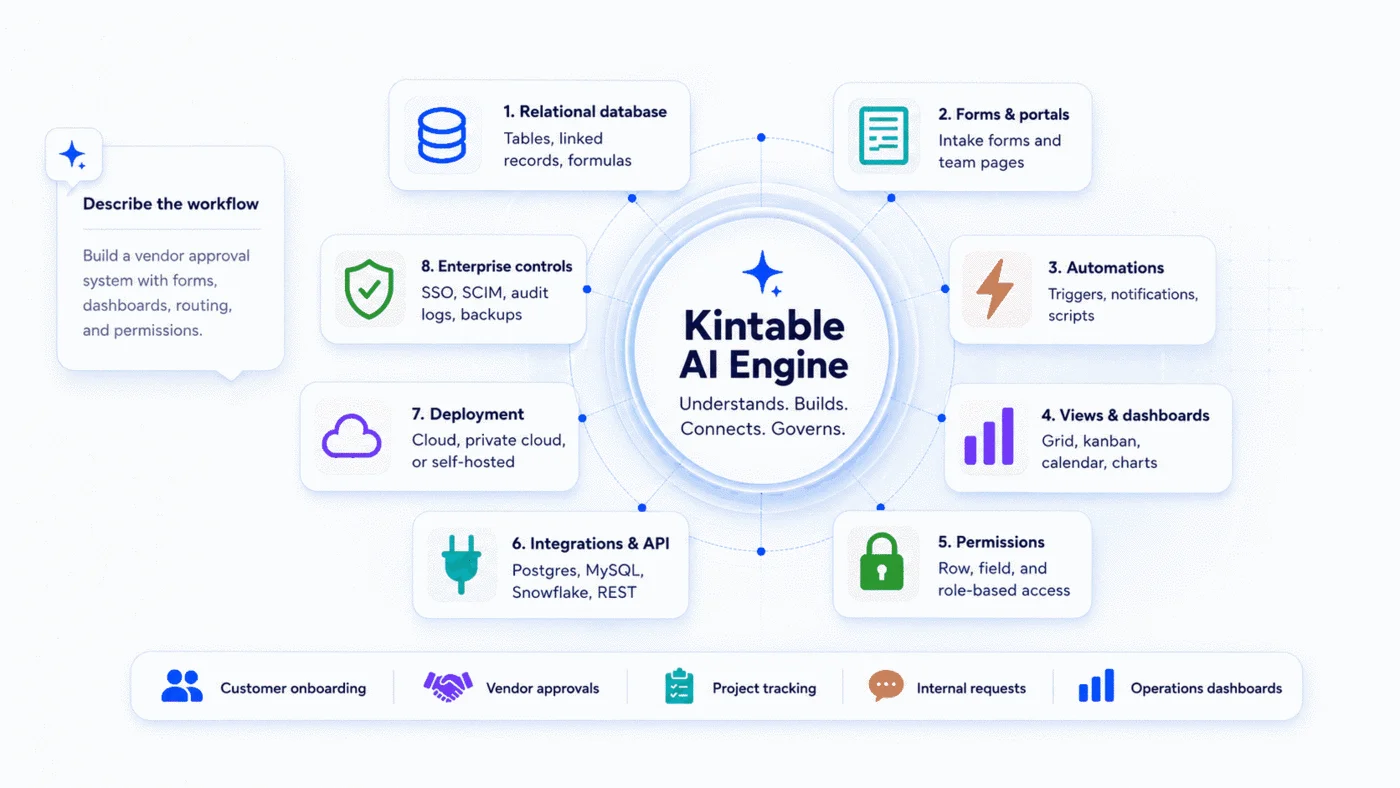
An AI system builder creates the operational structure around a process, not just a screen. It turns the work into connected records, roles, rules, views, actions, and external access.
Write what should happen in plain English: who starts the work, what data is needed, who approves it, and what the final outcome should be.
The prompt becomes linked tables, intake forms, status views, routing rules, automations, dashboards, and portals your team can inspect.
Ask for changes in plain English: add a field, change routing, connect Gmail, add a client view, or tighten permissions.
These are practical starting points for real search intent: approvals, portals, finance trackers, CRMs, intake, and operations dashboards.
Supplier intake, document collection, spend thresholds, finance routing, legal review, and audit history.
Client briefs, project milestones, file approvals, invoice status, and external updates without exposing internal data.
Budget categories, recurring bills, savings goals, account review tasks, and monthly reporting dashboards.
Investor, partner, customer, and hiring conversations with next steps, follow-up reminders, and pipeline views.
Candidate intake, interview stages, feedback collection, hiring approvals, and offer tracking.
Team queues, SLA risks, overdue work, proactive AI alerts, and connected records from your existing tools.
Kintable is built for the full system behind a process: governed data, roles, automations, audit history, and external access.
| Need | Kintable | Typical alternative |
|---|---|---|
| Start from plain English | One prompt creates the system draft. | Manual setup, templates, or developer work. |
| Keep data governed | Records, roles, permissions, and audit history stay together. | Data spreads across forms, sheets, and automation chains. |
| Work across tools | Connect Gmail, Slack, Stripe, QuickBooks, Shopify, HubSpot, databases, APIs, and more. | Separate glue tools and fragile point-to-point automations. |
| Let external people participate | Portals expose only the right records and actions. | Shared spreadsheets, email updates, or custom portals. |
For a deeper comparison, see Kintable alternatives, business process automation, spreadsheet replacement for business workflows, replacing spreadsheets with AI systems, and connecting business tools into one AI system.
Short answers written for buyers, builders, and AI search engines.
An AI system builder turns a plain-English business process into a working system with data, forms, routing logic, automations, dashboards, permissions, and portals.
Many AI app builders generate screens or prototypes. Kintable creates the governed system behind the work: relational records, intake, approvals, automations, integrations, permissions, and portals.
No. Business teams can describe the system they need in plain English. Technical users can still extend Kintable with JavaScript, REST APIs, webhooks, and database connections when needed.
Kintable connects to 116+ tools including Gmail, Slack, Stripe, QuickBooks, Shopify, HubSpot, Salesforce, PostgreSQL, MySQL, Snowflake, REST APIs, and webhooks.
Start with one prompt. Kintable creates the system draft, then you refine it with AI.