The short answer
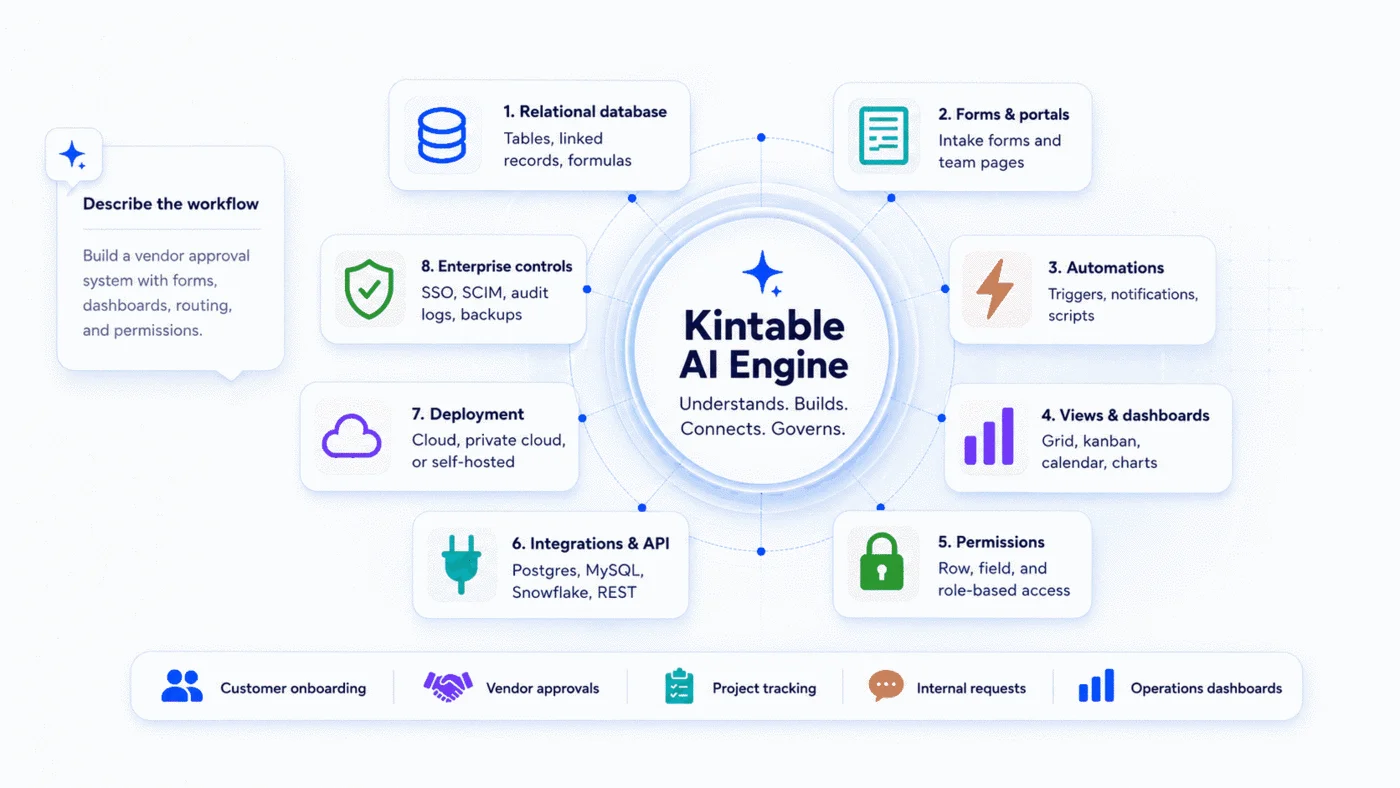
AI coding assistants generate code files, but leave hosting, databases, compliance (SSO, audit logs), and API maintenance to you. Kintable solves this by wrapping any model (Claude, Cursor, OpenAI, Gemini) in a managed, governed workspace.
When organizations need custom operational workflows (such as vendor onboarding, client portals, or approval chains), they often think about using AI coding assistants or raw LLMs directly to write code and build applications.
However, direct application generation using developer tools like Claude AI, Cursor, Codex, or Antigravity introduces severe compliance, infrastructure, and maintenance issues.
1. The Challenges of Building Directly with AI Assistants
While AI coding assistants are excellent for writing code blocks, they fail at delivering production-grade, compliant business systems out of the box.
Lack of Governance & Compliance
The assistant doesn't enforce security rules: Cursor or Claude can write React/Node code, but they do not automatically configure SAML 2.0 Single Sign-On (SSO), SCIM user provisioning, or row-level permissions. Furthermore, operations workflows (especially in finance and HR) require an immutable log of who approved what. Code assistants do not build or maintain strict compliance databases unless you prompt them for weeks to design a complex logging framework.
Infrastructure & Deployment Overhead
With raw developer assistants, you get code, but you still have to set up AWS/Vercel hosting, configure PostgreSQL databases, manage SSL certificates, and set up deployment pipelines. If you use an AI assistant to write scripts connecting Salesforce, Slack, and Stripe, those APIs will eventually change, leaving you responsible for debugging and rewriting the integration code when it breaks.
2. How Kintable Solves These Issues
Kintable is not a code assistant; it is a governed AI system platform. It acts as the structural, relational, and compliance layer, allowing you to use your preferred AI models to define the workflow.
Bring Your Own LLM (BYO-LLM) & LLM Neutrality
Kintable works with your organization's choice of AI models (Claude, Gemini, OpenAI, etc.). If your company standardizes on Claude (Anthropic) for privacy or Gemini (Google) for speed, Kintable connects directly to those models via API or private endpoint. This ensures business rules never leak to public model training sets.
Instant Compliance Out-of-the-Box
When Kintable generates an app, it wraps the entire system in an IT-approved shield: SSO/SCIM ready, row-level and field-level permissions, and automated audit trails. Every field change, approval click, and API invocation is permanently logged for SOC 2 reviews.
Build this system in minutes
Describe the workflow in plain English. Kintable generates the records, approvals, permissions, portal, and integrations — no code needed.
Key takeaways
- AI assistants generate code but leave you with the burden of server management, hosting, and database schema updates.
- Compliance controls (SAML SSO, SCIM, and audit logs) are native to Kintable but must be custom-developed with code assistants.
- Kintable is LLM-neutral, enabling you to bring your own enterprise-grade private LLM models.
- Integrations and APIs are managed automatically by Kintable, preventing brittle code breakage.