The shift
Most AI waits for a prompt. Kintable AI starts with your goals and connected business context. When revenue is the goal, it can surface stalled deals, overdue follow-ups, support risks, unpaid invoices, approval bottlenecks, and customer signals, then suggest the next action your team should take.
The popular version of AI is still a blank box. You type a question. It gives an answer. You decide what to do next. That is useful, but it still depends on a human constantly noticing the problem, gathering the context, writing the prompt, and moving the work forward.
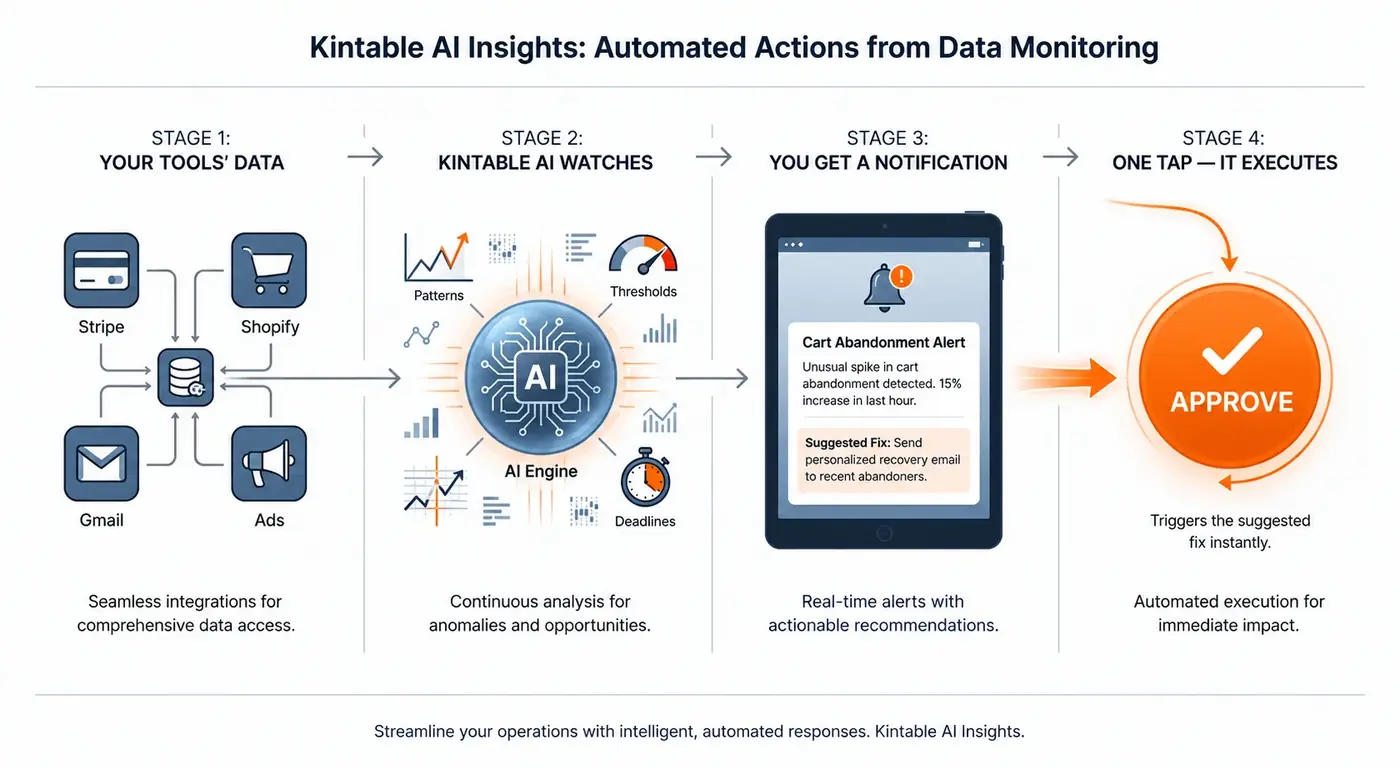
Kintable changes the pattern. Once your tools are connected and your workflows are structured, Kintable AI can watch the system around your goals. It does not only respond in chat. It can suggest what should happen next, route the suggestion to the right owner, prepare the action, and keep the decision connected to the record.
The future is not asking whether AI is smart. The better question is whether AI creates economic value. Does it increase revenue? Reduce cycle time? Prevent missed follow-ups? Remove manual work? Improve decisions? In Kintable, those questions are the point.
Start with a goal, not a prompt
Imagine your company defines a simple goal: increase revenue. In a normal AI chat tool, a manager might ask, "How do we increase revenue this quarter?" The answer may be smart, but it is generic unless the person manually provides context.
In Kintable, the goal can live inside the system. Kintable can look across connected records and tools: CRM activity, customer onboarding status, support tickets, unpaid invoices, marketing responses, renewal dates, approval queues, and sales follow-ups. The AI can see where revenue is stuck because the workflow context is structured.
Increase revenue, reduce churn, speed up onboarding, or clear stuck approvals.
Kintable checks connected records, tools, owners, dates, status, and constraints.
AI recommends the next best move, with reasoning and supporting context.
Humans approve sensitive actions; outcomes become memory for the next loop.
Example: increasing revenue with connected tools
Revenue is rarely blocked by one big thing. It is usually blocked by dozens of small misses: a lead that never got a second touch, a contract waiting on legal, a support issue that threatens renewal, an invoice exception that delayed onboarding, or a customer expansion signal that nobody saw.
When those signals live across separate systems, the team has to hunt for them. When they are connected through Kintable, AI can prompt the team with specific, economically valuable actions.
Autonomy and agency, with governance
Proactive AI is powerful only if it can act safely. Kintable is built around governed action: roles, permissions, approvals, audit logs, structured records, and integration boundaries. AI can recommend and prepare actions, but teams decide which actions require human approval.
That matters because business autonomy is not the same as unsupervised automation. A low-risk reminder can be sent automatically. A contract change, refund, pricing exception, or customer-impacting decision can route to a person with the full context already prepared.
This is where Kintable differs from generic AI chat. Kintable AI has a system to act inside: records, workflows, dashboards, portals, and integrations. That system gives AI agency without losing control.
Economic value is the new benchmark
The AI conversation is moving from intelligence to value. It is no longer enough to ask, "Can AI answer this question?" The better benchmark is: "Did AI create measurable business value?"
More timely follow-ups, faster onboarding, better expansion signals, and fewer stalled opportunities.
Less waiting between intake, approval, handoff, escalation, and customer response.
Fewer status meetings, copied updates, spreadsheet checks, and repetitive coordination tasks.
Kintable is designed for that benchmark. The value does not come from a clever response alone. It comes from AI using structured context to suggest actions that move the business goal forward.
Why connected tools matter
AI cannot suggest valuable actions if it cannot see the work. A disconnected chatbot does not know that a customer just submitted a complaint, a contract is waiting for approval, a deal has gone silent, or a payment issue is blocking onboarding.
Kintable connects workflows around tools your team already uses: Gmail, Slack, HubSpot, Salesforce, Stripe, QuickBooks, calendars, forms, databases, and portals. Once the work is connected, Kintable AI can see patterns that a person might miss and prompt the team before the opportunity is lost.
This is why Kintable works as an AI system builder, not just a chat assistant. The AI has structured places to observe, reason, suggest, act, and learn. Teams can start with a revenue workflow, an approval workflow, or an AI client portal, then let the system suggest the next best actions as the work runs.
The loop compounds
Every suggested action creates a record. Every approval creates a decision. Every outcome becomes context. Over time, the system learns which actions create value and where the business gets stuck.
That is the compounding advantage. Teams that use AI only as a chat tool get isolated answers. Teams that use Kintable build operational memory: what worked, what did not, who approved it, what changed, and what should happen next.
The divide will not be between companies that have AI and companies that do not. It will be between companies whose AI is connected to economic action and companies whose AI is still waiting for someone to type the perfect prompt.
Key takeaways
- Kintable AI can suggest actions from connected tools and goals instead of waiting for generic prompts.
- Goal-driven AI is most valuable when it can see workflow context: records, owners, approvals, customers, invoices, and tool activity.
- Autonomy needs governance: permissions, human approvals, audit logs, and clear action boundaries.
- The real AI benchmark is economic value: revenue lift, cycle-time reduction, and manual work removed.
Let Kintable AI suggest the next best action
Connect your tools, define the goal, and give your team a governed system that recommends what to do next.