Structured PO intake form
Requesters submit POs with vendor, line items, amounts, GL code, delivery date, and business justification. Forms validate required fields, check vendor authorization status, and create workflow records automatically.
Purchase Order Workflow
Most PO workflows are a combination of email approvals, shared spreadsheets, and manual QuickBooks entry. When a PO sits in someone's inbox for a week, no one knows. Kintable generates a governed PO workflow — structured intake, spend-tier routing, vendor authorization check, approval chain, and accounting sync — that gives finance real-time visibility into every open PO.
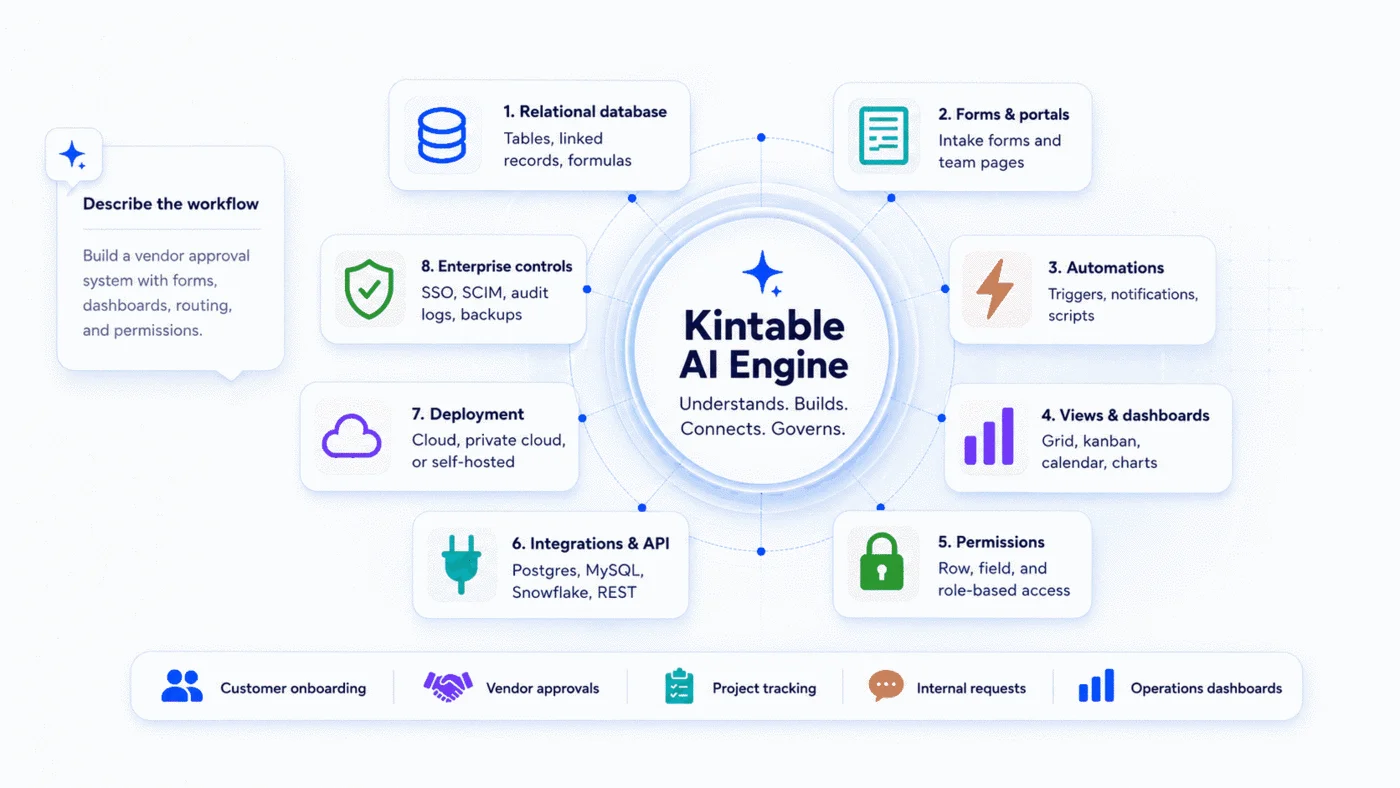
PO intake, vendor check, spend-tier routing, approval chain, audit trail, and accounting sync — generated as one connected workflow.
Requesters submit POs with vendor, line items, amounts, GL code, delivery date, and business justification. Forms validate required fields, check vendor authorization status, and create workflow records automatically.
Route by amount: department manager for under $5K, VP for $5K–$25K, CFO for $25K–$100K, board approval for over $100K. Add per-category rules and emergency PO paths — all generated from the workflow description.
Flag POs submitted for unauthorized or unapproved vendors before they enter the approval queue. Route new vendor requests through the vendor onboarding workflow automatically.
Every PO submission, approval, rejection, modification, and payment logged with actor, timestamp, and prior value. Exportable for finance audit, SOX compliance, and external auditor review.
Approved POs sync to QuickBooks Online, NetSuite, or Xero automatically. GL codes assigned by category. PO number generated and returned to the requester. No manual re-entry.
Notify approvers when a PO has been waiting more than 24 hours. Escalate to the next tier if still pending after 48 hours. Finance gets a dashboard of all POs by age, tier, and department.
Name the spend tiers, the approvers at each level, the vendor authorization rules, and where approved POs go.
"Create a purchase order workflow. Employees submit PO requests with vendor name, amount, line items, GL code, and business justification. Check if the vendor is on the approved vendor list. Route POs under $10K to the department manager, $10K–$50K to the VP of Finance, over $50K to the CFO. Flag POs for unapproved vendors and route to procurement for vendor review first. Sync approved POs to QuickBooks with the correct GL code. Send weekly open PO summary to the finance team. Alert the requester and the CFO if any PO has been waiting more than 72 hours."
Different departments have different purchasing patterns and thresholds. Kintable generates department-specific rules within one unified PO system.
Software licenses, hardware, cloud services, and contractor POs — with recurring vs. one-time spend rules and IT security review for new software vendors.
Agency fees, media spend, event costs, and creative services — with campaign budget tracking, PO-to-invoice matching, and quarterly budget rollup.
Maintenance contracts, facilities services, and capital equipment — with multi-year contract routing and depreciation schedule tagging.
Lab supplies, research tools, and prototype materials — with project code tagging, budget tracking, and grant-funded PO routing.
Purchase order systems handle financial data and vendor information. Kintable includes the controls finance and IT require.
Teams building PO workflows are also exploring expense approval automation, vendor management software, and broader procurement workflow platforms.
Automate employee expense reimbursements alongside PO approvals — spend-tier routing, receipt capture, and QuickBooks sync.
Vendor intake portal, authorization tracking, contract routing, and document collection — the vendor layer of the PO workflow.
The full procurement workflow hub — PO approvals, vendor management, contract routing, and invoice processing.
Short answers for teams evaluating purchase order workflow options.
Purchase order workflow software automates the PO process from request to payment: a structured intake form, spend-tier routing to the right approvers, vendor authorization checks, a notification system, an audit trail, and integration with the accounting system for approved PO sync. Kintable generates this complete PO workflow from a plain-English description of the procurement policy — spend thresholds, approver tiers, vendor rules, and accounting codes.
To automate PO approvals: (1) define the intake form — line items, GL codes, vendor, and justification; (2) set the spend-tier routing rules — which amounts go to which approvers; (3) add vendor authorization checks; (4) configure notifications and escalation timers; (5) connect to QuickBooks or NetSuite for approved PO sync. In Kintable, all five steps are generated from one plain-English prompt describing the procurement policy.
A complete PO approval workflow includes: a structured request form with line items and GL codes, spend-tier routing rules, vendor authorization validation, a multi-step approval chain, SLA timers with escalation, a compliance audit trail, and accounting system integration for approved PO sync. It should also include a finance dashboard showing all open POs by department, age, and tier. Kintable generates all of these as a unified workflow.
Kintable connects to QuickBooks Online natively. When a PO is approved in the workflow, it syncs automatically — PO number generated, line items and GL codes transferred, vendor record matched. No manual re-entry between the approval system and QuickBooks. The integration is configured during workflow generation: describe which expense categories map to which GL codes and Kintable sets up the sync.
Yes. Kintable generates multi-tier approval chains with conditional routing by spend amount, department, vendor type, or any other field. For example: under $5K routes to the department manager, $5K–$25K routes to the VP, over $25K routes to the CFO, over $100K requires board approval. Each tier can have different SLA timers, notification rules, and escalation paths. All of this is defined in the workflow prompt and generated automatically.
Kintable generates the intake form, routing rules, audit trail, and QuickBooks sync — ready in under an hour.