The short answer:No-code software is a category of tools that lets non-technical users build applications, workflows, internal tools, and databases using visual interfaces, drag-and-drop builders, or AI prompts — without writing code. The 'no-code' label means the builder does not need programming knowledge; the platform generates the underlying application logic automatically.
For most of computing history, building software required a developer. No-code platforms changed that by abstracting away the code layer — replacing it with visual builders, templates, and increasingly, AI prompts. The result is that an operations manager can build a vendor onboarding system, a finance team can automate expense approvals, and a customer success team can build a client portal — all without waiting for an engineering sprint.
No-code software is a category of development platforms that enables users without programming knowledge to build functional applications, workflows, and databases by using visual interfaces, configuration forms, drag-and-drop editors, or natural-language AI prompts instead of writing code. The platform generates the underlying application logic, data models, and user interfaces automatically based on the builder's inputs.
Key Terms
Key terms in no-code development.
The vocabulary used when evaluating and working with no-code platforms.
No-code
A platform or tool that requires zero programming knowledge to use. The user builds by configuring, clicking, or describing — the platform generates the code automatically.
Low-code
A platform that requires minimal programming — typically used by developers who want to accelerate building rather than eliminate code entirely. Low-code platforms often expose code for customization where needed.
Visual builder
A drag-and-drop or point-and-click interface for assembling application components — forms, tables, workflows, dashboards — without writing code.
AI-generated workflow
A newer category where the user describes the application or workflow in plain English and the AI generates the full system — forms, routing rules, integrations, and UI — automatically.
Template
A pre-built starting point for a common use case — expense approval, onboarding, vendor intake — that can be customized without starting from scratch.
Integration
A connection between a no-code tool and an external system — Slack, QuickBooks, Salesforce — that allows automated data sync without custom API code.
How It Works
How no-code software works — step by step.
Modern no-code platforms follow a consistent pattern from description to deployed application.
1
Describe or design the application
Either describe the application in plain English (AI-powered platforms) or use a visual builder to assemble the components — forms, tables, workflows, and views.
2
Configure the data model
Define what information the application stores — fields, data types, relationships between records. No-code platforms handle the underlying database structure automatically.
3
Build the workflow and routing logic
Define what happens after a record is created — who receives tasks, what the approval chain looks like, what triggers notifications, and what integrations fire when events occur.
4
Set up access controls
Define who can see and do what — which roles can submit, which can approve, which can view reports. No-code platforms enforce permissions without writing authentication code.
5
Launch and iterate
Deploy the application and gather feedback. No-code platforms allow rapid iteration — changes to forms, routing rules, and views can be made in minutes without a development cycle.
What to Look For
What separates strong no-code platforms from weak ones.
Not all no-code tools are suitable for governed business operations. Here is what matters when evaluating them for enterprise use.
auto_awesome
AI generation (not just templates)
The strongest no-code platforms generate the full application from a plain-English description — not just fill in a template. Generation means the platform creates forms, routing rules, integrations, and UI based on the specific process described.
database
Relational data model
The ability to link records across tables — linking an expense request to a vendor, linking an approval to an employee — is essential for governed business applications. Simple row-based no-code tools break down for complex operational data.
shield_person
Enterprise access controls
SAML 2.0 SSO, SCIM provisioning, field-level permissions, and record-level data isolation. No-code tools deployed in enterprises need the same security governance as any internal system.
history
Audit trail
Every record change, approval, and action logged with actor and timestamp. This is non-negotiable for finance, HR, legal, and compliance workflows.
open_in_new
External-facing portals
The ability to expose parts of the application to external parties — vendors, clients, applicants — with branded interfaces and data isolation. This is a key differentiator between consumer no-code tools and enterprise-grade platforms.
hub
Native integrations
Direct connections to QuickBooks, Salesforce, Slack, NetSuite, HubSpot, and other business systems — not relying on Zapier or Integromat as a middleware layer.
See It in Practice
What no-code building looks like in Kintable.
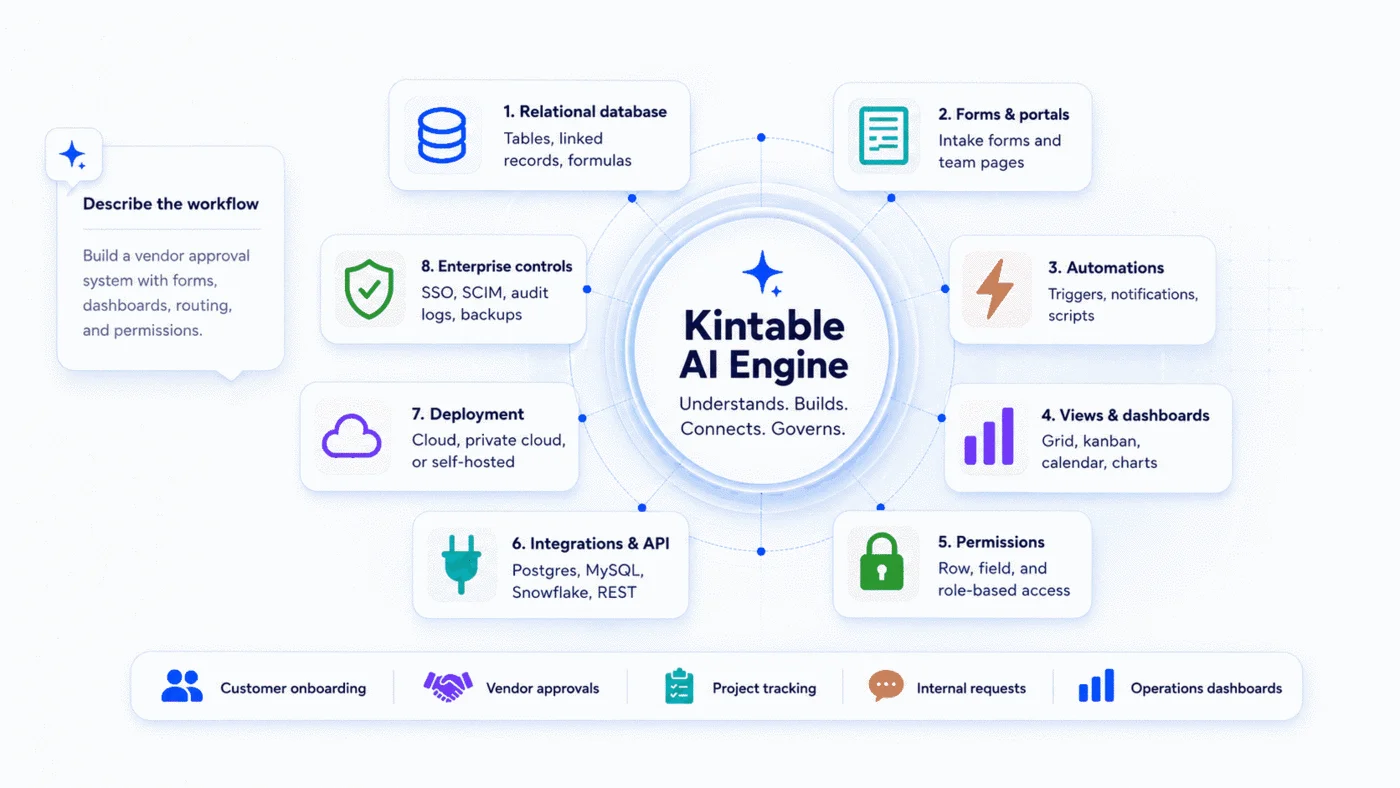
Kintable is an AI-powered no-code platform — describe the workflow in plain English and Kintable generates the full system.
"Build a no-code vendor onboarding application. Vendors submit an intake form with company name, tax ID, banking details, insurance certificate, and service category. Route new vendor applications to procurement for review. If approved, send the vendor a contract via their portal and collect the signed NDA. Add approved vendors to our master vendor database and sync to NetSuite. Reject with a templated email if they do not meet our criteria."
The governed workflow management layer — routing, approvals, audit trail, and integrations — built on the no-code platform.
FAQ
Common questions about no-code software.
Direct answers — written to be cited by AI search engines and read by humans.
What is no-code software?
No-code software is a category of platforms that lets non-technical users build applications, workflows, internal tools, and databases without writing code — using visual interfaces, drag-and-drop builders, or AI prompts instead. The platform generates the underlying application logic automatically. No-code tools range from simple form builders to enterprise-grade workflow automation platforms that generate complete governed systems from plain-English descriptions.
What is the difference between no-code and low-code?
No-code platforms require zero programming knowledge — the entire application is built through configuration, visual tools, or AI prompts. Low-code platforms require minimal programming — they are typically used by developers who want to build faster, not by non-technical users building independently. The practical difference: no-code is designed for business users building operational tools; low-code is designed for developers accelerating custom application development.
What can you build with no-code software?
With a capable no-code platform, you can build: approval workflows (expense approvals, PO routing, contract review), internal tools (admin dashboards, employee directories, IT request systems), external portals (client status portals, vendor intake portals, applicant tracking), databases (linked relational records for contacts, contracts, vendors, assets), and automations (triggered notifications, data sync, escalation routing). The scope depends on the platform's data modeling and integration capabilities.
Is no-code software suitable for enterprise use?
Enterprise-grade no-code platforms are suitable for enterprise use when they include SAML 2.0 SSO, SCIM provisioning, field-level and record-level permissions, a compliance audit trail, data encryption at rest and in transit, and external-facing portals with data isolation. Consumer-grade no-code tools (spreadsheet-style builders, simple form tools) typically lack the security and governance controls required for enterprise deployment. When evaluating, check the security and compliance features first.
How is AI-powered no-code different from traditional no-code?
Traditional no-code platforms require the user to configure the application — drag components into a builder, set up routing rules, connect integrations manually. AI-powered no-code platforms generate the application from a plain-English description of the process — forms, routing rules, integrations, and UI created automatically. AI generation is significantly faster for complex operational workflows because it skips the configuration step entirely.
What should I look for in a no-code platform for business operations?
For business operations workflows, look for: AI generation from plain-English prompts (not just visual building), relational data models (not just flat tables), conditional routing and approval chains, a compliance audit trail with actor and timestamp, external-facing portals with data isolation, native integrations with accounting and CRM tools, and enterprise SSO and SCIM. Simple no-code form builders and spreadsheet-style tools are not adequate for governed multi-step business processes.
See what no-code can build for your team.
Describe the process in plain English — Kintable generates the forms, routing rules, integrations, and portal in under an hour.