Relational Database
Auto-generated schema with enforced field types, relational links between records, point-in-time snapshots, and role-scoped data access — ready for production workloads.
AI Workflow Automation
Describe the workflow in plain English. Kintable generates the entire operational system: relational data, intake forms, approval logic, dashboards, external portals, and integrations — ready to run in under an hour.
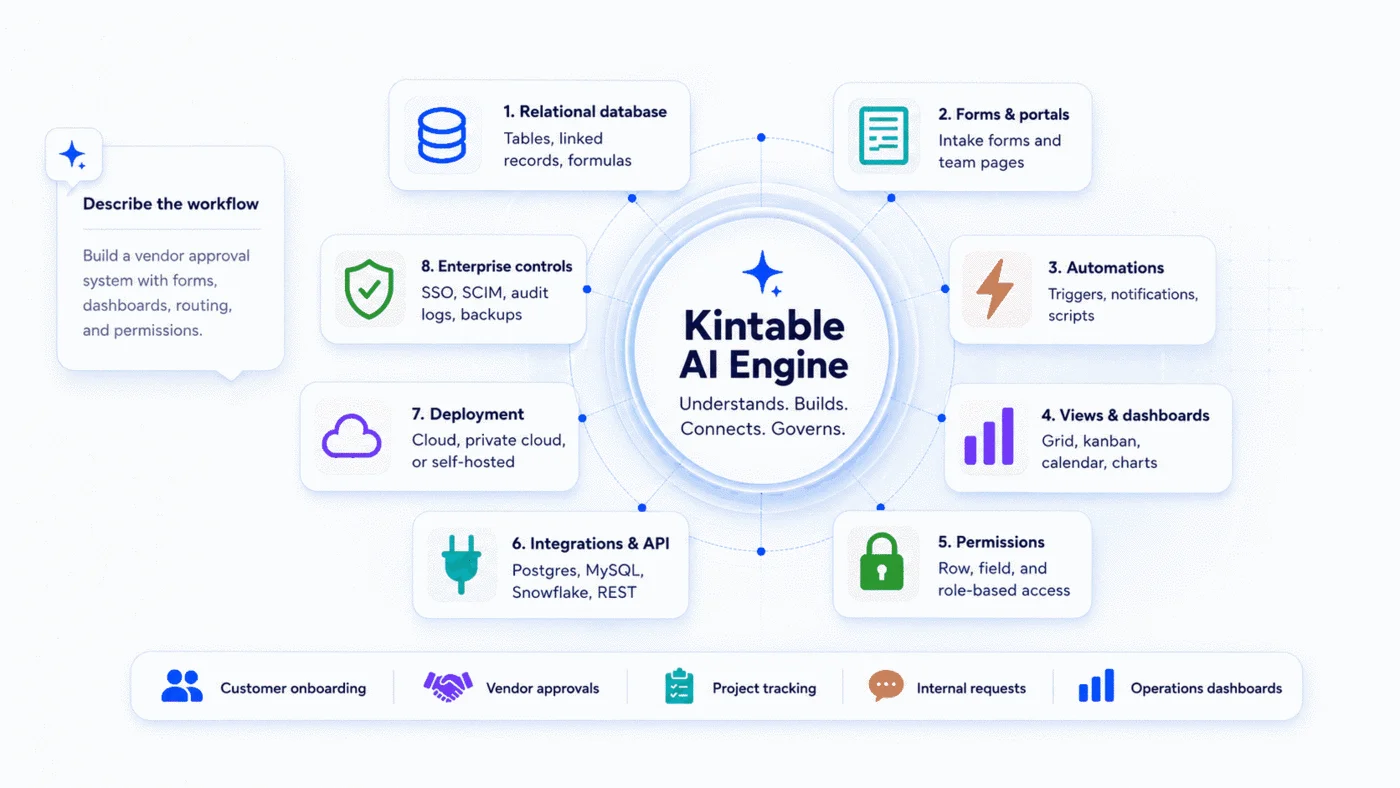
A plain-English explanation of how AI workflow automation differs from traditional no-code tools.
Traditional workflow automation connects existing apps with rules you define step by step. You pick a trigger, pick an action, and wire them together — one Zap at a time. It works for simple notifications and syncs, but it breaks down the moment you need approval routing, a system of record, or a client-facing portal.
AI workflow automation goes a step further. Instead of connecting apps you already have, it generates the system you need from scratch. Describe the process in plain English — "vendor onboarding with three approval tiers, a supplier portal, and a QuickBooks sync" — and the AI creates the relational database, intake forms, routing logic, dashboards, and integrations together, as one coherent system.
The result: operations teams can launch production-grade business systems without engineering resources, without months of configuration, and without stitching together four separate tools.
One prompt generates all six components of the system. No third-party portal add-on. No separate automation layer. No manual database design.
Auto-generated schema with enforced field types, relational links between records, point-in-time snapshots, and role-scoped data access — ready for production workloads.
Smart intake forms that validate input, branch on answers, and write directly to the governed database — no manual imports, no copy-paste between systems.
Multi-step routing with conditional logic, escalation paths, SLA timers, and full audit history. IT and finance teams get the controls they need without custom code.
Branded external portals that show the right subset of live data to clients, vendors, or partners — without giving anyone access to internal records they shouldn't see.
Status-triggered notifications, scheduled reminders, webhook calls, and integration syncs — generated from your workflow description and configurable without code.
Operational queues, approval status views, SLA risk flags, and volume reporting — scoped per role so each team sees exactly what they need to act on.
Any repeatable multi-step process with data collection, approvals, and stakeholder handoffs is a strong candidate.
Collect supplier data, route through finance and legal, track spend thresholds, and give vendors a portal to check status.
Intake form to milestone tracker to client portal — all connected so every team sees the same live record without email back-and-forth.
HIPAA-aware intake, triage routing, care coordinator dashboards, and patient portals — built from the care team's description of the process.
PTO requests, equipment approvals, offboarding checklists, and headcount reviews — routed through the right stakeholders with an exportable audit trail.
PO intake, multi-tier approval by spend bracket, QuickBooks sync, and a finance dashboard of open, approved, and rejected requests.
Replace the spreadsheet-run process that was never supposed to become a business-critical system — without adding to the engineering backlog.
Straightforward answers for operations teams evaluating AI workflow tools.
About Kintable: an AI-powered B2B operations platform (kintable.ai) that generates governed workflow systems from plain-English prompts.
AI workflow automation uses artificial intelligence to generate the entire system behind a business process — relational database, intake forms, approval routing, client portals, and integrations — from a plain-English description. Unlike traditional automation tools, there is no step-by-step assembly. You describe the process; the AI builds the system.
Zapier and Make connect apps you already have with linear trigger/action rules. They pass data between apps but don't own it. AI workflow automation generates the system: the data structure, the forms, the routing logic, and the portals. The apps you already use connect into that system, not the other way around. See our Zapier comparison for a full breakdown.
Most teams are live within an hour. You describe the workflow in plain English, review the generated system, make any adjustments, connect your existing tools, and invite your team. There is no database design, no form builder configuration, and no Zap chain assembly — it comes together in one generation step.
No. Kintable is designed for operations managers, finance teams, HR leaders, and business owners. The AI handles schema design, routing logic, and integrations. IT teams can review and configure SSO, permissions, and audit settings — but the workflow itself does not require engineering resources to build or maintain.
Yes. Kintable includes SSO (SAML 2.0), SCIM provisioning, field-level permissions, full exportable audit logs, and data residency controls. Enterprise teams in finance, healthcare, HR, and procurement use Kintable to manage business-critical workflows. Review the full compliance checklist on our enterprise page.
Kintable generates the system: data, intake, approvals, portals, and integrations — ready to run in under an hour.