The short answer
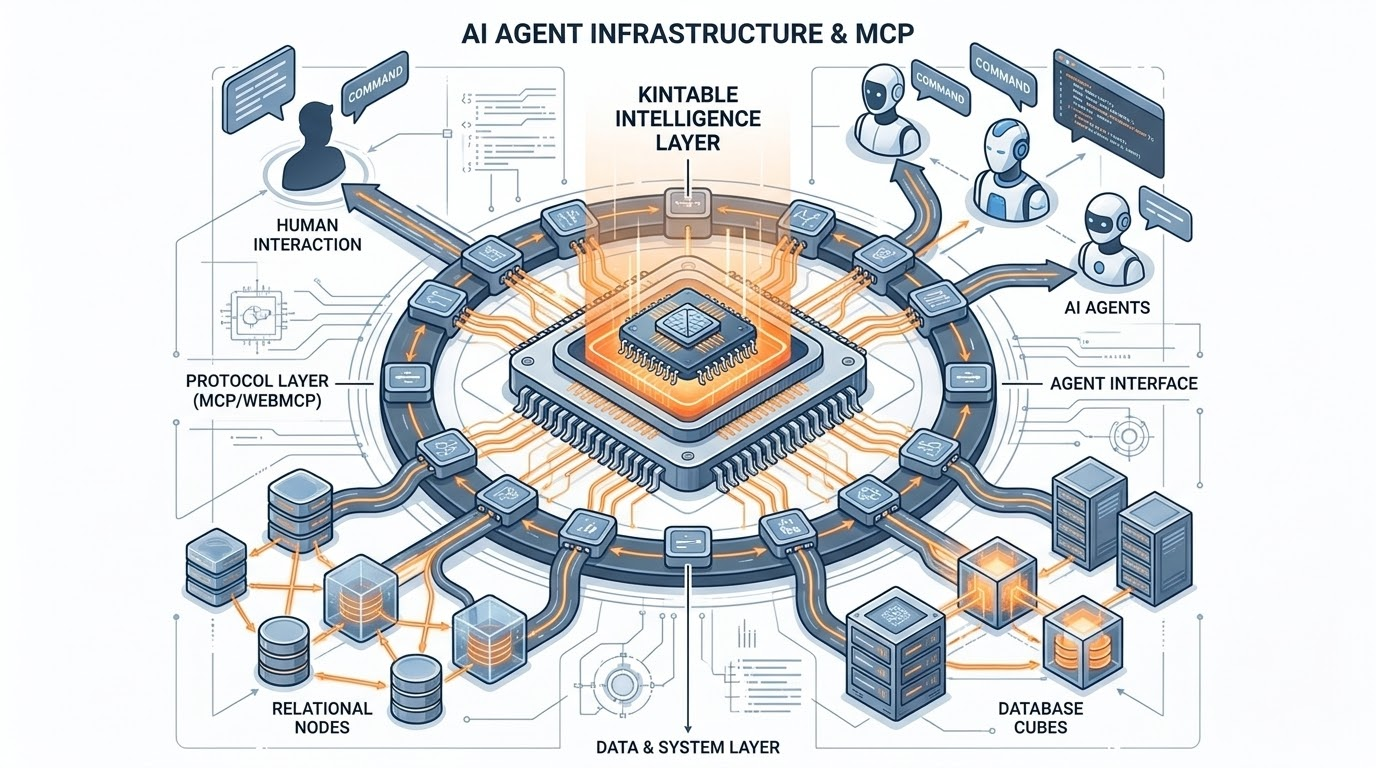
MCP makes business systems usable by AI agents through standard tool and data interfaces. WebMCP is an emerging approach for making web pages easier for agents to understand and operate. Kintable is building generated apps so teams get these AI-ready foundations automatically, without having to wire protocols by hand.
Most software was designed for humans clicking screens. The next wave of software has to work for people and for AI agents acting on their behalf. That means applications need more than a good UI. They need clear actions, structured data, safe permissions, stable metadata, and machine-readable intent.
This is why Model Context Protocol and WebMCP research matter. They are different layers of the same shift: apps should expose what they know and what they can do in a way AI agents can use reliably.
What MCP does: standardized connections for data and tools
MCP, short for Model Context Protocol, is an open standard for connecting AI applications to external systems. The official MCP documentation describes it as a way for AI applications like Claude or ChatGPT to connect to data sources, tools, and workflows. Anthropic introduced MCP in November 2024 as a universal way to connect AI systems with business tools and data sources, reducing the need for one-off connectors.
The important idea is simple: instead of every AI product needing a custom integration for every business system, a system can expose tools and resources through a common protocol. Agents can then ask for the right context or perform approved actions through that interface.
"The transition from Chat UI to Agentic API isn't just a technical upgrade — it's a fundamental shift in how business value is captured. The winners will be apps that can safely explain themselves to agents."
What WebMCP adds: making web pages understandable
MCP is mostly about connecting AI applications to tools and data. WebMCP is about the web interface itself becoming easier for agents to understand. The webMCP paper describes a client-side standard that embeds structured interaction metadata into web pages, so agents can understand page actions without parsing the whole page like a human would.
In practical terms, WebMCP points toward websites and apps that can say, "Here are the important actions on this page. Here is what this form means. Here is what this button does. Here is the data boundary." That matters because agentic browsing is becoming a real product surface, not a research toy.
| Protocol | What it helps AI agents do | How Kintable prepares apps |
|---|---|---|
| MCP | Connect to structured tools, records, prompts, and workflows through a standard interface. | Apps are generated with clear records, actions, permissions, audit trails, and integration boundaries. |
| WebMCP | Understand what a web page means, which actions are available, and how to interact with the UI efficiently. | Generated pages use semantic structure, canonical metadata, stable actions, and agent-friendly documentation. |
Why the industry is moving this way
Anthropic created and open-sourced MCP. OpenAI supports MCP in its Agents SDK. The official MCP site lists ecosystem support across Claude, ChatGPT, Visual Studio Code, Cursor, and other developer tools. Anthropic also named Block, Apollo, Zed, Replit, Codeium, and Sourcegraph among early companies working with MCP or adopting it in their platforms.
That company list matters. This is not just another integration format. It is a signal that AI applications are becoming operating layers over business systems. The winners will be the apps that can safely explain themselves to agents and give agents the right tools to act.
Security focus: why governed agent access matters
Agent-ready apps cannot be built with enthusiasm alone. WebMCP security research has already identified new risks around tool surfaces and runtime manipulation. That is why Kintable treats security, permissions, audit trails, and controlled actions as core system features, not add-ons.
Policy Enforcement
Real-time validation of agent actions against role-based permissions and compliance rules defined in the workflow.
Immutable Audit Trail
Every agent interaction, approval, and data change is logged as part of the workflow record for post-action review.
What Kintable supports today
Kintable already builds the foundation that MCP and WebMCP expect from serious business software:
- Structured data: apps are based on records, fields, relationships, statuses, and views instead of loose chat output.
- Explicit actions: workflows have named actions such as submit, approve, reject, route, notify, escalate, sync, and publish.
- Permission boundaries: role-based access and enterprise controls define who can see and change each part of the system.
- Auditability: approvals, updates, and automations are logged as part of the workflow record.
- Agent-friendly public pages: Kintable's own site includes structured metadata, sitemap coverage, canonical URLs, and LLM documentation through llms.txt.
Build apps ready for the AI-agent era
Describe the workflow in plain English. Kintable generates the records, approval routing, permissions, client portal, and integrations — no code needed.
The bottom line
MCP and WebMCP are part of a larger change in how software works. Business apps are becoming surfaces that humans use directly and AI agents operate through safely. Kintable is built for that direction: generated systems with structured data, governed actions, external portals, integrations, and metadata that make work understandable beyond the UI.
If your team builds on Kintable, you should not have to rebuild later for the agent-ready web. The application structure should already be moving in that direction.
Useful places to learn more
To follow how this ecosystem is taking shape, start with the official MCP introduction, Anthropic's MCP announcement, OpenAI's Agents SDK MCP documentation, the webMCP research paper, and newer WebMCP security research.