Structured intake forms
Forms that validate data, adapt based on prior answers, and create governed workflow records automatically — replacing the 'fill in a Notion page' process.
Notion Alternative
Notion captures knowledge and tracks work flexibly. Kintable governs how work moves: who submits requests, who reviews them, who approves them, who gets notified externally, and what the audit log shows. When the process needs structure, not flexibility, Kintable generates the governed system from one prompt.
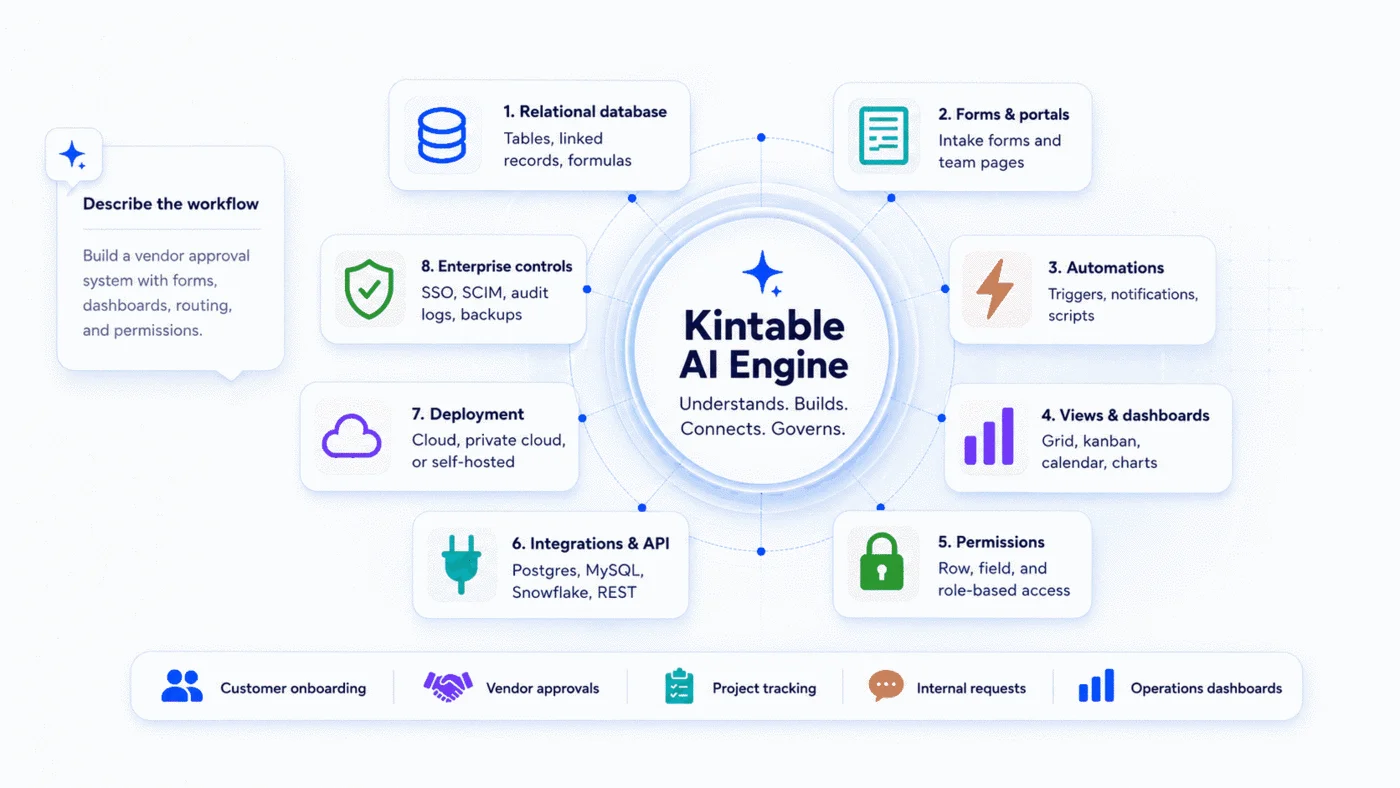
Notion is built for knowledge work — documentation, planning, and collaboration. Kintable is built for operational work — intake, routing, approvals, external portals, and compliance.
| Need | Kintable | Notion |
|---|---|---|
| Intake forms | Generates structured intake forms with conditional logic, validation, and automatic routing. | Forms in Notion are limited — no conditional routing, no automatic record creation with workflow rules. |
| Approval routing | Multi-step conditional approval routing with escalation paths and SLA timers. | No native multi-step approval routing. Teams use Notion for status tracking, not structured approvals. |
| External portals | Branded portals for vendors, clients, or applicants — with strict data isolation. | Notion pages can be made public but do not support governed external portals with data isolation. |
| Audit trail | Every record change, approval, and action logged with timestamp, actor, and prior value. | Page history available but not designed for compliance-grade audit export. |
| Permissions | Field-level and record-level permissions enforced at the database layer. | Notion permissions are at the page and workspace level — not field-level or record-level. |
| Best fit | Operations, finance, HR, and procurement teams running processes that need structure and governance. | Knowledge workers, teams, and individuals who need flexible documents, wikis, and lightweight databases. |
Kintable generates the intake forms, routing rules, external portals, and audit trail that Notion database workflows lack.
Forms that validate data, adapt based on prior answers, and create governed workflow records automatically — replacing the 'fill in a Notion page' process.
Requests route to the right reviewers automatically — by spend tier, department, request type, or any field value. No manual status column changes.
Give vendors, clients, or applicants a governed portal to submit requests, check status, and upload documents — with data isolation from internal records.
Field-level and record-level access control enforced at the data layer. Finance sees spend. Legal sees contracts. Requesters see their own submissions.
Every action logged with timestamp, actor, and prior value — exportable for compliance, legal, or audit review.
SAML 2.0 SSO and SCIM provisioning for enterprise IT requirements — not available in Notion's standard offering.
Most teams start with 'we have a Notion database for this' — then describe what they wish it could do automatically.
"Create a purchase request system. Employees submit requests with vendor, amount, business justification, and supporting documents. Route requests under $5K to the department manager, over $5K to the finance director, over $25K to the CFO. Show each requester their submission status. Export a monthly spend report for the finance team."
The clearest sign: your team is manually moving Notion database entries from one status to another, emailing people to take action, and reconstructing approval history from Slack messages.
Operations, finance, HR, procurement, and legal teams that need structured intake forms, conditional approval routing, external portals, and a compliance audit trail — not a flexible database.
Knowledge workers, product teams, and startups that primarily need documentation, wikis, meeting notes, planning databases, and flexible workspace — where structure is secondary to flexibility.
An honest look at both tools. The right choice depends on whether your team needs a workflow system generated or an existing tool configured.
Teams comparing Notion and Kintable are often also looking at Airtable alternatives, approval workflow software, and workflow automation platforms.
Comparing with Airtable too? See how Kintable differs from database-first tools that need manual automation stacking.
See how Kintable handles structured multi-step approvals with routing, audit trail, and external portals.
Compare Kintable with Notion, Airtable, Monday.com, Retool, Make, and more by use case.
Short answers for teams deciding between Notion and a generated workflow system.
If your team tracks approvals in a Notion database — moving items between status columns and emailing stakeholders to take action — Kintable is a purpose-built alternative. It generates the structured intake form, the conditional routing rules, the approval chain, and the audit trail from a plain-English description of the process. The most common trigger: 'we are doing this in Notion but it is getting too manual.'
Notion is a flexible workspace built for knowledge work — documentation, wikis, lightweight databases, and team collaboration. Kintable is a workflow system generator built for operational governance — structured intake, conditional routing, multi-step approvals, external portals, and a compliance audit trail. Notion values flexibility; Kintable values structure and governance. Both are legitimate choices, for different types of work.
For vendor onboarding intake, document collection, approval routing, and status tracking — yes. Kintable generates the complete vendor management workflow, including a supplier portal, document expiry tracking, multi-tier approval routing, and audit logging. Teams typically keep Notion for vendor knowledge documentation — onboarding guides, playbooks, reference material — and move the vendor workflow to Kintable.
Kintable includes structured data tables with linked records, multiple views (table, Kanban, dashboard), and filtered views by role. It does not support Notion's flexible page-within-a-database nesting or freeform document editing. Kintable is designed for structured operational data — where schema, permissions, and routing rules matter — not for flexible knowledge bases where the structure varies by page.
Kintable generates the governed system — structured intake, conditional routing, external portals, and audit trail — ready in hours.
Notion is a trademark of its respective owner. This page is not affiliated with, sponsored by, or endorsed by Notion. Feature comparisons are based on publicly available documentation and are provided for informational purposes only.