AI generation from a prompt
Describe the governance workflow — who submits, who reviews, what the routing rules are. Kintable generates the complete system in under an hour without a ServiceNow developer.
ServiceNow Alternative
ServiceNow governs enterprise IT and service management at scale. Kintable governs business operations workflows — vendor intake, purchase approvals, contract routing, HR requests, client onboarding — for teams that need the governance layer without the platform investment, implementation timeline, and dedicated admin required to run ServiceNow.
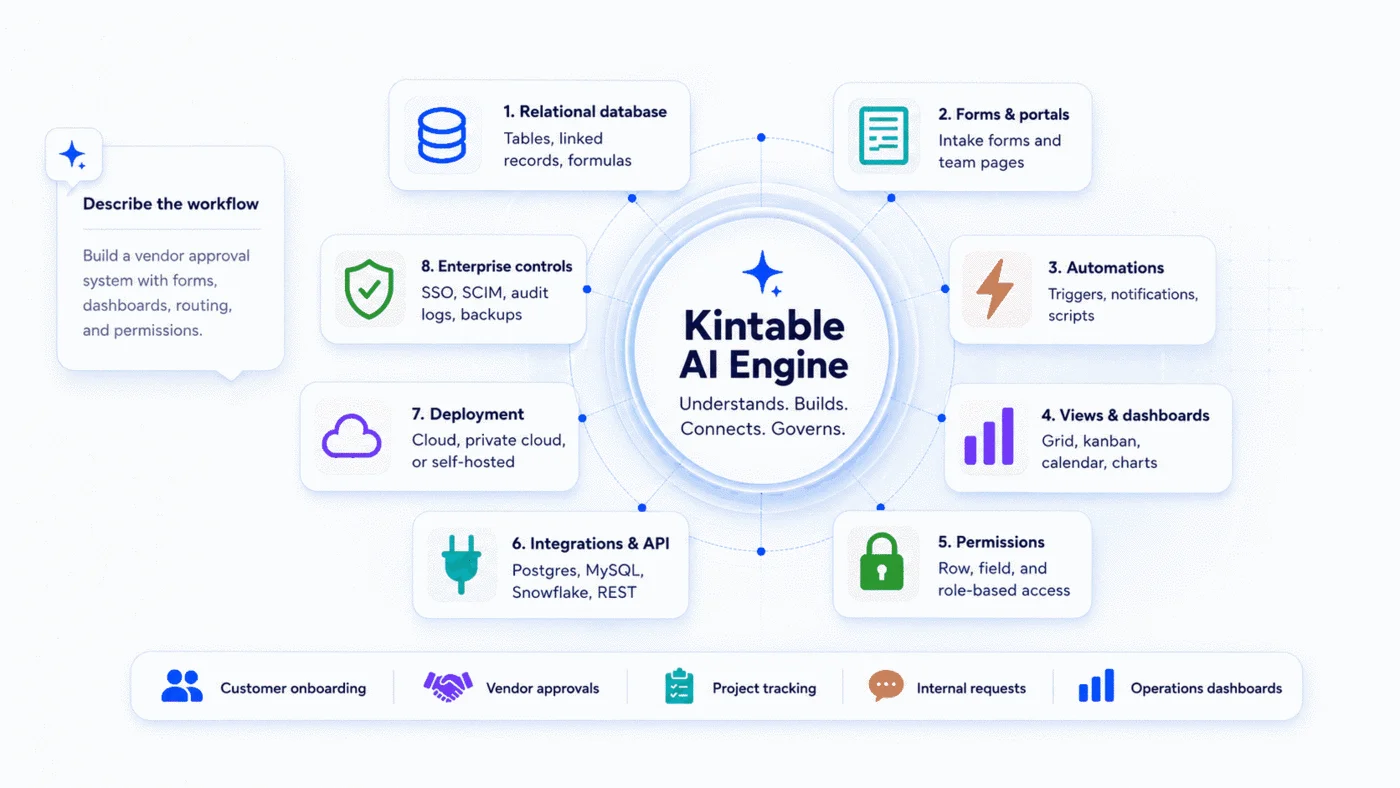
ServiceNow is built for large enterprise IT organizations with dedicated platform teams. Kintable is built for mid-market business operations teams that need governance without the platform overhead.
| Need | Kintable | ServiceNow |
|---|---|---|
| Time to first workflow | Under 1 hour — describe the process in plain English and Kintable generates the intake, routing, portal, and audit trail. | Multi-month implementation — scoping, configuration, testing, training, and go-live with a dedicated admin team. |
| Target team size | Mid-market teams of 20–500 users across ops, finance, HR, procurement, legal, and CS. | Large enterprise IT organizations (500+ users) with dedicated ServiceNow admins and implementation partners. |
| Starting point | One prompt generates structured records, intake forms, routing rules, portals, and audit trail. | Platform configuration — workflows, tables, scripts, and forms designed by certified ServiceNow developers. |
| Intake forms | Generates intake forms with conditional logic, validation, and automatic routing. | Service catalog items require ServiceNow form design, flow configuration, and catalog client scripts. |
| External portals | Branded portals for vendors, clients, or applicants with data isolation — generated alongside the workflow. | Service Portal is available for IT service requests — configuring portals for external vendor or client workflows requires additional development. |
| Total cost | Transparent per-user pricing. Free tier available. Enterprise plans by consultation. | Enterprise licensing with per-user costs, implementation partner fees, and ongoing admin costs — typically reserved for large enterprise budgets. |
Kintable generates the intake, routing, portals, permissions, and audit trail that mid-market teams need — without requiring a platform implementation project.
Describe the governance workflow — who submits, who reviews, what the routing rules are. Kintable generates the complete system in under an hour without a ServiceNow developer.
Multi-tier approval routing with spend thresholds, escalation paths, and SLA timers — the core governance capability, generated from plain English.
Branded portals for vendors, clients, or applicants generated alongside the internal workflow — with data isolation and role-based access enforced at the database layer.
Every record change, approval, and action logged with timestamp, actor, and prior value — exportable for compliance, legal, and finance audit review.
SAML 2.0 SSO and SCIM provisioning — the enterprise IT requirements that make Kintable deployable alongside ServiceNow under the same identity governance.
Slack, email, CRM, ERP, and accounting integrations triggered by workflow events — connected to each governed record, not a separate flow configuration.
Most teams considering ServiceNow need the governance outcome — intake, routing, audit trail, and portals — not the full ITSM platform. Describe the process.
"Create a vendor risk assessment workflow. The procurement team submits new vendor requests with company info, spend estimate, data access scope, and risk tier. Route low-risk vendors to the procurement manager for approval. Route medium and high-risk vendors to Legal and IT Security for review before procurement final approval. Give each vendor a status portal. Log every review action with timestamp for compliance. Flag overdue reviews in Slack after 5 business days."
The clearest signal: your team needs approval routing, external portals, and audit trails — and ServiceNow is either out of budget, too complex to implement, or longer to deploy than the business need requires.
Mid-market operations, finance, HR, procurement, and legal teams that need governed workflow systems with intake, approval routing, external portals, and compliance audit trail — deployable in hours without an implementation partner.
Large enterprise IT organizations (typically 500+ users) that need a unified platform for ITSM, ITOM, HR Service Delivery, security operations, and enterprise-wide service management — with the budget, admin team, and timeline to support a full platform deployment.
An honest look at both tools. The right choice depends on whether your team needs a workflow system generated or an existing platform configured.
Teams comparing ServiceNow and Kintable are often also evaluating enterprise workflow automation, procurement workflow software, and approval workflow platforms.
Enterprise workflow automation with SSO, SCIM, and full audit trail — the governance layer without the ServiceNow platform overhead.
Vendor intake, spend-tier approval routing, and procurement governance — a common ServiceNow replacement use case.
Compare Kintable with ServiceNow, Jira, Smartsheet, Monday.com, Airtable, and more by use case.
Short answers for teams deciding between ServiceNow and a generated workflow system.
For mid-market operations, finance, HR, and procurement teams that need governance — intake forms, conditional approval routing, external portals, and compliance audit trails — without a multi-month ServiceNow implementation, Kintable is a purpose-built alternative. It generates the governed workflow system from a plain-English description in under an hour, with SSO and SCIM included for enterprise IT requirements.
ServiceNow is a comprehensive enterprise platform for IT service management deployed by large organizations with dedicated admin teams and multi-month implementation timelines. Kintable is an AI-generated workflow system builder for mid-market business operations teams — generating intake, approval routing, external portals, and audit trail from a plain-English prompt in under an hour. ServiceNow covers the breadth of enterprise IT; Kintable covers the depth of business process governance.
Yes. Many teams use ServiceNow for IT service management and Kintable for business operations workflows — procurement approvals, vendor risk assessments, contract routing, HR intake. Kintable connects via REST API and webhooks to ServiceNow, so an approved vendor request in Kintable can trigger an IT provisioning ticket in ServiceNow. The two tools are complementary for organizations that need IT governance in ServiceNow and operational governance in Kintable.
Kintable includes SAML 2.0 SSO, SCIM provisioning, field-level and row-level permissions, compliance-grade audit trail (actor, timestamp, prior value), AES-256 encryption at rest, and TLS 1.2+ in transit. For teams whose enterprise requirements stop there, Kintable is deployable under standard IT review. For organizations that require ServiceNow's full ITSM, ITOM, or security operations capabilities, those needs are outside Kintable's scope.
A standard operations workflow in Kintable — intake form, conditional routing, external portal, audit trail — takes under an hour to generate and deploy. ServiceNow implementations typically range from 3 to 12 months depending on the modules, scope of customization, data migration, and training required. The time difference is the primary reason mid-market teams consider Kintable as a ServiceNow alternative — the governance outcome is similar; the deployment timeline is not.
ServiceNow is a trademark of its respective owner. This page is not affiliated with, sponsored by, or endorsed by ServiceNow. Feature comparisons are based on publicly available documentation and are provided for informational purposes only.
Kintable generates the governed workflow system — intake, approval routing, external portals, and audit trail — ready in hours.