Structured records
Linked data for requests, vendors, contracts, customers, approvals, invoices, and outcomes — in one governed system, not scattered across tools.
Make Alternative
Make orchestrates work between the tools you already have. Kintable generates the workflow system itself — structured records, intake forms, conditional approval routing, external portals, and dashboards — so there is something governed to automate from, not just wires between spreadsheets and email.
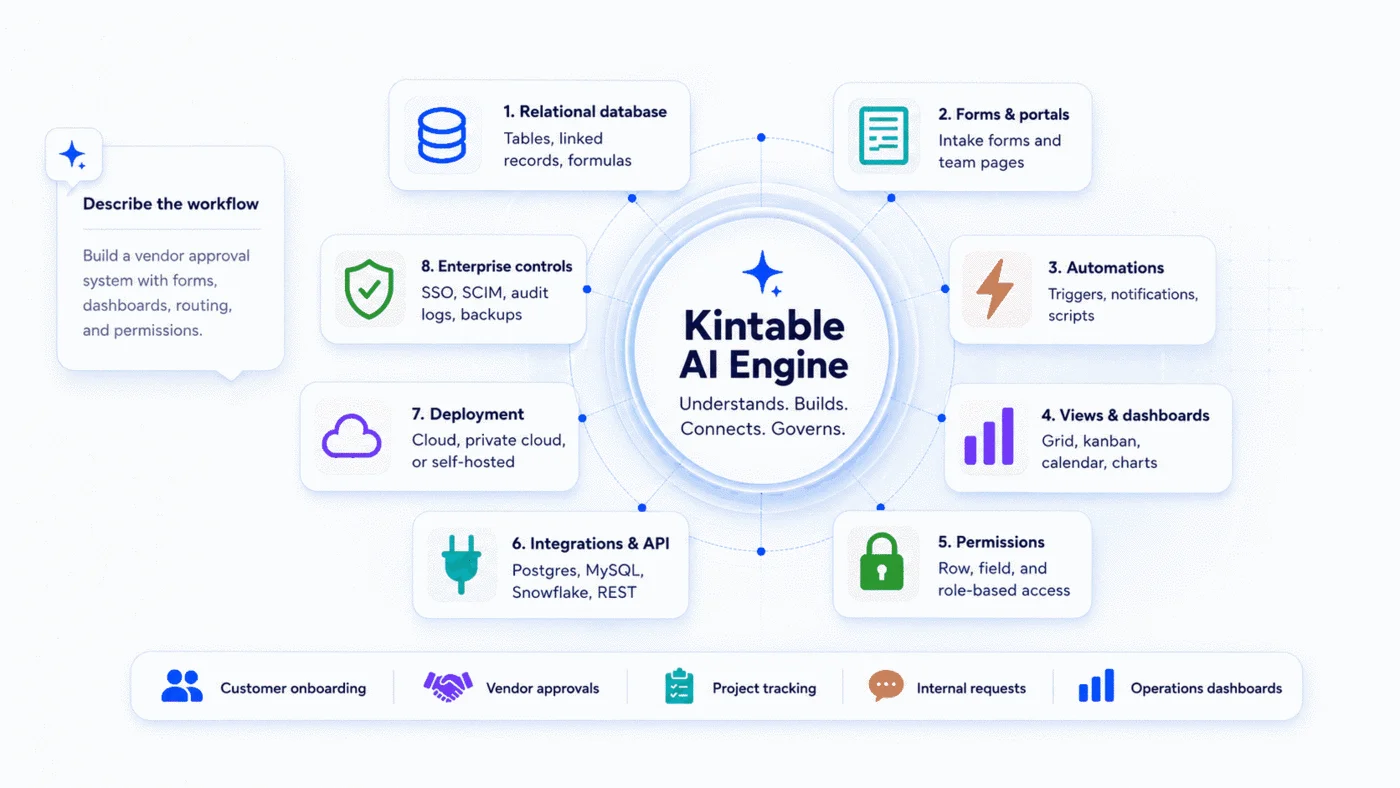
Make is exceptional at connecting existing applications. Kintable generates the application: the structured records, the intake forms, the routing rules, the portals, and the audit trail.
| Need | Kintable | Make |
|---|---|---|
| Starting point | Generates the workflow system from a plain-English prompt — records, forms, routing, portals, dashboards. | Connects and automates between tools you already have (CRM, spreadsheet, email, Slack, etc.). |
| Data ownership | Structured records live in Kintable — searchable, permissioned, auditable. | Data lives in the source systems Make connects. Make itself does not store or govern records. |
| Intake forms | Generates intake forms and portals that create workflow records automatically. | Does not generate intake forms. Relies on forms from connected tools (Typeform, Google Forms, etc.). |
| Approval routing | Multi-step conditional approval routing with escalation and audit trail built in. | Can route notifications between tools, but approval logic requires significant scenario configuration. |
| External portals | Branded external portals for vendors, clients, or applicants — with data isolation. | External-facing interfaces require a separate tool (Softr, Webflow, etc.) connected via Make. |
| Best fit | Teams that need a governed workflow system generated and owned in one place. | Technical teams automating complex workflows between many existing applications and APIs. |
Kintable gives you structured data, intake forms, approval routing, external portals, and dashboards as a unified system — not five separate tools wired together.
Linked data for requests, vendors, contracts, customers, approvals, invoices, and outcomes — in one governed system, not scattered across tools.
Forms that validate, adapt based on answers, and create governed workflow records automatically on submission — no scenario needed.
Route requests through the right reviewers based on field values — no complex scenario builder for conditional logic.
Email, Slack, CRM updates, and external notifications triggered by workflow events — as part of the system, not a separate scenario.
Every record change, approval, and action logged with timestamp and actor — built into the system, not a webhook to a logging tool.
Field-level and row-level permissions, SSO, and SCIM — so the governed system passes IT review without additional access control tooling.
Instead of designing a scenario with triggers and actions, describe the process end to end. Kintable generates the records, forms, routing, portals, and dashboards.
"Create a client onboarding system. New clients submit their company info, signed contract, and technical requirements. Route to the account manager for review, then to the technical team for setup. Give each client a portal to track their onboarding progress, upload additional documents, and see milestone completions. Notify the team in Slack when a client has been waiting more than 3 days."
If the work is routing through email and spreadsheets and you are trying to connect the pieces with Make scenarios, Kintable can generate the governed system those pieces should live in.
Teams that need structured records, intake forms, approval routing, external portals, and dashboards as a unified governed system — without a developer or an automation specialist.
Technical teams with multiple existing applications to connect — CRMs, ERPs, APIs, spreadsheets, communication tools — where the goal is automating complex data flows and notifications between them.
An honest look at both tools. The right choice depends on whether your team needs a workflow system generated or an existing tool configured.
Teams comparing Make and Kintable are often also evaluating Zapier alternatives, AI workflow builders, and business process automation platforms.
Compare Kintable with Zapier — when you need the workflow system behind the automations, not just the triggers.
See how one prompt generates intake, routing, records, portals, and dashboards as a unified workflow system.
Compare Kintable with Make, Zapier, Airtable, Retool, Bubble, Monday.com, and more by use case.
Short answers for teams deciding between Make and a generated workflow system.
If your team is using Make to automate processes that lack a structured workflow system — routing requests through Google Forms, Sheets, and email — Kintable is a strong alternative. It generates the governed system those automations would run on: structured records, intake forms, approval routing, external portals, and dashboards, without a scenario builder.
Make connects your existing applications with powerful automation scenarios. Kintable generates the workflow system itself — structured data, intake forms, conditional approval routing, external portals, and dashboards as a unified platform. The key difference: Make assumes you have tools to connect; Kintable generates the governed system that becomes the source of record for the process.
Yes. Kintable connects via REST API, webhooks, and native integrations to tools like Slack, HubSpot, QuickBooks, Google Workspace, and more. Many teams use Kintable for the workflow system and Make or Zapier for more complex cross-application data flows. The two are complementary, not mutually exclusive.
Use Make when your team needs to automate complex data flows between many existing applications — ERP systems, CRMs, legacy APIs, and communication tools — with advanced filtering, branching, and error handling. Kintable is the stronger choice when the need is a governed workflow system with structured records, intake forms, approval routing, external portals, and audit trails.
Kintable generates the governed workflow system — structured records, intake forms, approval routing, and external portals — ready in hours.
Make is a trademark of its respective owner. This page is not affiliated with, sponsored by, or endorsed by Make. Feature comparisons are based on publicly available documentation and are provided for informational purposes only.