Branded external portals
Client, vendor, partner, or applicant portals with your branding — generated alongside the internal workflow. Clients see their data only; internal teams see everything.
Softr Alternative
Softr adds a portal UI to data that already lives in Airtable or Google Sheets. Kintable generates both: the portal AND the governed workflow system behind it — structured records, intake forms, conditional approval routing, and audit trail — in one system, not two.
Softr is a portal builder that sits on top of your Airtable base. Kintable generates the portal and the workflow system together — no separate data layer required.
| Need | Kintable | Softr |
|---|---|---|
| Data layer | Generates its own structured records — no Airtable subscription required. | Requires an existing Airtable base or Google Sheet as the data source. |
| Intake forms | Generates intake forms with conditional logic, validation, and automatic routing. | Forms in Softr create records in your Airtable base — no conditional routing built in. |
| Approval routing | Multi-step conditional approval routing with escalation paths and audit trail. | No native approval routing. Requires Airtable automations or Zapier for routing logic. |
| Audit trail | Every action logged with timestamp, actor, and prior value — exportable for compliance. | No compliance-grade audit trail. Activity depends on Airtable's revision history. |
| SSO & SCIM | SAML 2.0 SSO and SCIM provisioning for enterprise IT requirements. | SSO available on higher Softr plans. SCIM not natively supported. |
| Best fit | Teams that need the portal and the workflow system together with governance built in. | Teams that already have an Airtable base and want to add a customer or member portal UI. |
Kintable eliminates the Softr + Airtable + Zapier stack by generating the portal, the data layer, and the approval routing as one governed system.
Client, vendor, partner, or applicant portals with your branding — generated alongside the internal workflow. Clients see their data only; internal teams see everything.
Approval logic built into the workflow — not Airtable automations triggered by status changes. Route by field value, spend tier, or any condition.
Governed data in Kintable — not a third-party Airtable base. Linked records, permissioned views, and role-based access at the data layer.
Every portal interaction, approval decision, and status change logged with timestamp and actor — exportable for enterprise compliance review.
SAML 2.0 SSO and SCIM provisioning for internal teams — not available without additional configuration in the Softr + Airtable stack.
Client A cannot see Client B's data — enforced at the database query layer, not just UI filtering.
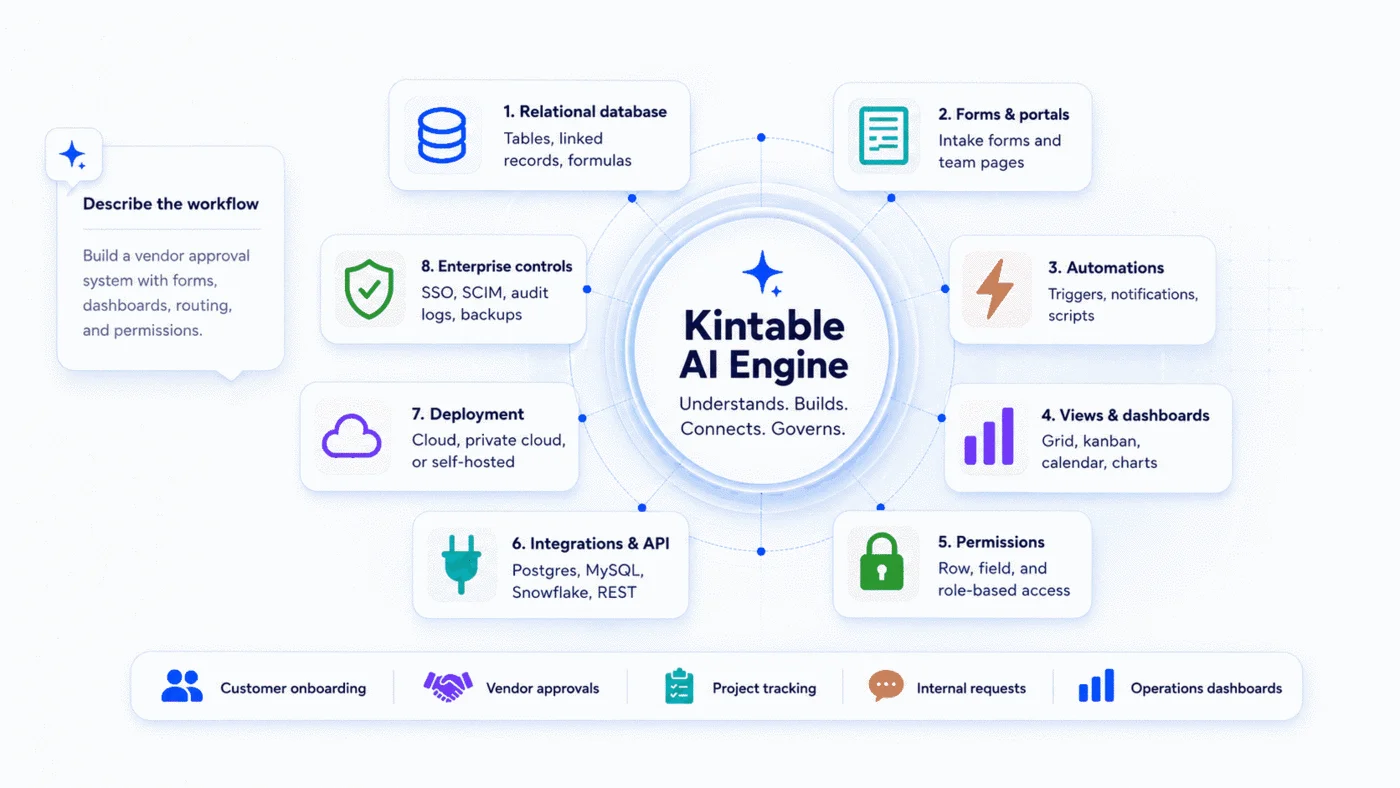
Kintable generates the portal and the workflow system behind it — intake, routing, permissions, and audit trail — without managing a separate Airtable base.
"Build a client portal for our agency. Each client logs in and sees their project status, deliverables, and outstanding document requests. Clients can upload assets, approve milestone deliverables, and submit change requests. Internally, the account manager reviews change requests, routes them to the project lead for approval, and updates the client-facing status automatically."
If your Softr portal routes approvals through Airtable automations and Zapier — and the audit trail is a revision history on a spreadsheet — Kintable generates the governed system underneath.
Teams building client portals, vendor portals, or applicant portals where the process behind the portal requires structured intake, multi-step approvals, data isolation, SSO, and a compliance audit trail.
Teams with an existing Airtable base that want to add a membership site, customer portal, or internal tool UI — where the data lives in Airtable and the portal is primarily a display and interaction layer.
An honest look at both tools. The right choice depends on whether your team needs a workflow system generated or an existing tool configured.
Teams comparing Softr and Kintable are often also evaluating Airtable alternatives, client portal builders, and enterprise portal software.
See how Kintable generates client, vendor, and partner portals with data isolation and workflow integration.
Comparing the data layer too? See how Kintable replaces the Softr + Airtable stack with one generated system.
Compare Kintable with Softr, Airtable, Bubble, Glide, AppSheet, and more by use case.
Short answers for teams deciding between Softr and a generated workflow system.
If your team uses Softr on top of Airtable for client portals but needs SSO, a compliance audit trail, approval routing, or data isolation enforced at the database layer — Kintable is a strong alternative. It generates the portal and the workflow system together, with enterprise IT requirements included by default.
Softr is a portal builder that adds a UI layer to an existing Airtable or Google Sheets database. Kintable generates both: the portal interface and the governed workflow system behind it — structured records, intake forms, conditional approval routing, audit trail, SSO, and data isolation — as one system, from one prompt. The key difference: Softr needs Airtable. Kintable generates the data layer alongside the portal.
Yes. Kintable connects via REST API and webhooks to Airtable and other tools. Teams often migrate their Airtable base into Kintable's structured records — where approval routing, portal generation, and audit trail are built in — rather than maintaining the Softr + Airtable + Zapier stack separately.
Kintable portal branding supports logo, colors, and custom domain. Softr offers more design-level template customization for teams that need consumer-grade UI control. For operational portals — vendor onboarding, client status, applicant tracking — Kintable's generated portal meets the need without a design project. For polished consumer-facing member portals or directories, Softr's design depth is stronger.
Kintable generates the portal and the workflow system behind it — intake, approval routing, audit trail, and SSO — in one governed system.
Softr is a trademark of its respective owner. This page is not affiliated with, sponsored by, or endorsed by Softr. Feature comparisons are based on publicly available documentation and are provided for informational purposes only.